What Is the Cheapest Way to Buy US Stocks With Crypto?
The cheapest way to buy US stocks with crypto depends on the total all-in cost, not just trading fees. Learn how gas fees, withdrawal costs, and spreads impact your investment and see a cost comparison.
What Is the Cheapest Way to Buy US Stocks With Crypto?
The cheapest way to buy US stocks with crypto is determined by the total, all-in cost of ownership, not just the advertised trading fee. While many platforms promote low commission rates, the true cost often includes a series of other charges: gas fees for on-chain transactions, deposit and withdrawal fees, custody fees, and the price difference from slippage. When you account for all these expenses, the most cost-effective solution is one that minimizes or eliminates them entirely.
Finding a genuinely cheap way to gain equity exposure requires looking beyond the headline number. The process of moving value from crypto to stocks can involve multiple steps, each with its own cost. Selling crypto on an exchange, wiring fiat to a traditional broker, and then paying brokerage fees creates a chain of value extraction. On-chain solutions can be more direct, but often pass network gas fees to the user, which can be unpredictable and high.
At GM Markets, we designed our platform to address this directly. We provide a clear and transparent pricing model built around a single trading fee. By abstracting gas costs, offering free deposits and withdrawals, and eliminating custody fees, we provide a more direct and cost-effective path for investors to buy tokenized US stocks with their crypto assets.
Deconstructing the True Cost of Buying Stocks with Crypto
To accurately compare platforms, you must first understand every potential fee. The total cost of a transaction is the sum of many parts, and some are less obvious than others. Here are the primary components that contribute to the all-in cost:
- Trading Fees: This is the most visible cost, usually charged as a percentage of the trade value (basis points) or a flat fee per transaction. This can also include spreads, where the fee is hidden in the price quote.
- Gas Fees: For on-chain transactions, this is the network fee required to pay validators or sequencers to process your trade. It can fluctuate significantly based on network congestion. According to data from L2BEAT, a simple transfer can cost several dollars on Ethereum mainnet but less than a cent on Layer 2 networks like Base or Arbitrum.
- Deposit & Withdrawal Fees: These are charges for moving funds onto or off a platform. This can include fees for crypto withdrawals to an external wallet or for fiat wire transfers from an exchange to a bank account.
- Custody & Inactivity Fees: Some platforms charge ongoing fees for holding your assets or penalize you for not meeting a minimum trading frequency. This can also take the form of annual management fees on tokenized fund products.
- Slippage: This is the difference between the price you expect to pay for an asset and the price you actually pay when the trade executes. It is a hidden cost that is common in automated market maker (AMM) pools and on volatile order books.
- FX & Conversion Fees: These costs arise when you have to convert between different assets to make a purchase, such as selling USDT for USD on an exchange, which may include a spread or a direct fee.

Comparing the Costs: Three Common Pathways
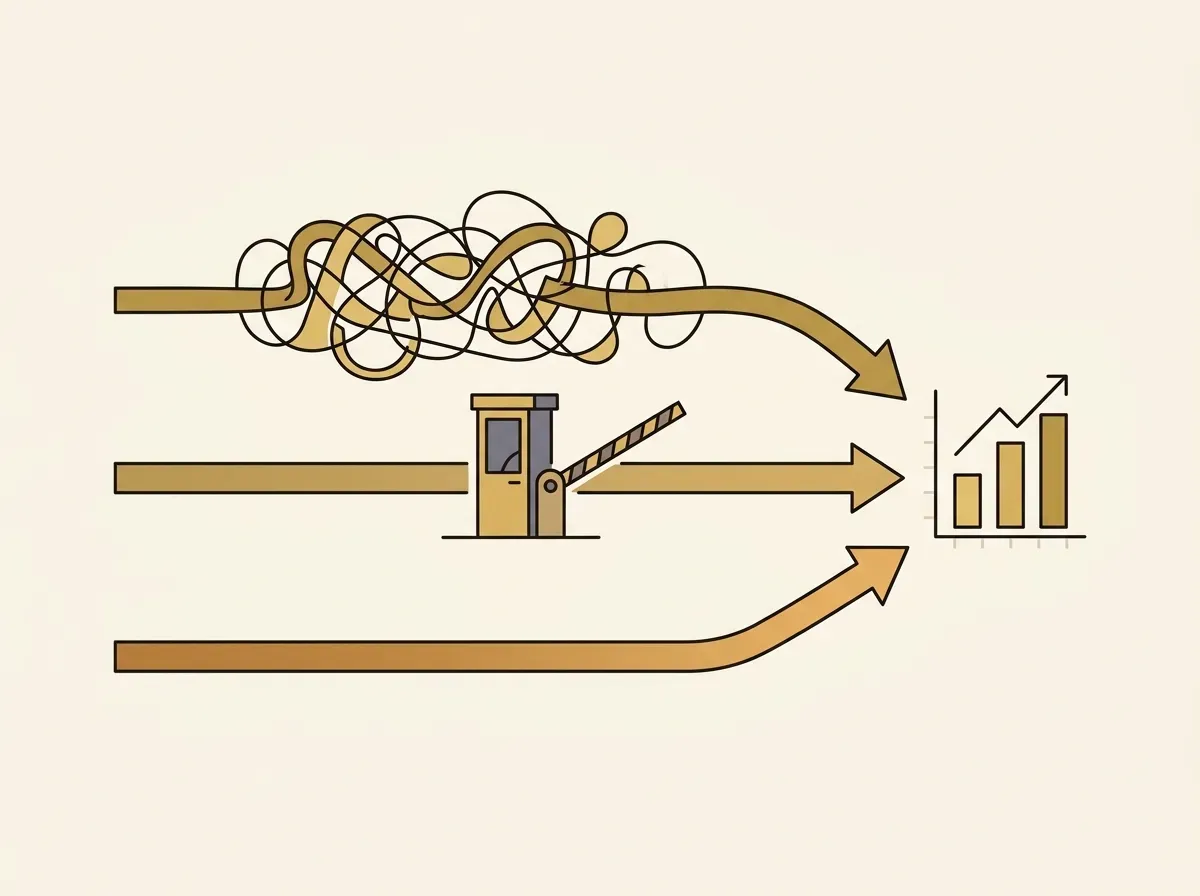
Investors typically use one of three methods to buy stock exposure with crypto. As the table below illustrates, the total cost varies dramatically depending on the path you choose. All claims are based on publicly available fee schedules as of June 2026.
| Cost Component | Pathway 1: Traditional Brokerage | Pathway 2: Centralized Crypto Exchange | Pathway 3: GM Markets |
|---|---|---|---|
| Trading Fees | Varies by broker + crypto sale fees (e.g., 0.40% taker on Kraken Pro) | ~0.10% maker/taker fee (e.g., Bybit, KuCoin) or a spread (e.g., 0.05% on Binance) | 0.10% to 0.20% (all-in) |
| Gas Fees | User pays crypto network fees when moving assets to the exchange to sell. | Not applicable for internal trades, but paid by user on withdrawals. | $0 (abstracted by our platform) |
| Deposit Fees | Brokerage deposits often free, but exchange deposits for fiat can have costs (e.g., $10 wire fee on Coinbase). | Crypto deposits are usually free. | $0 (for stablecoin, card, and bank) |
| Withdrawal Fees | Crypto exchange wire fees (e.g., $25 on Coinbase) + potential intermediary bank fees. | Varies by asset and network (e.g., ~$1.60 for USDT on TRC20). | $0 |
| Custody Fees | Generally none for retail brokers. | Generally none. Can include management fees on other platforms (e.g., 0.15% on Ondo's OUSG). | $0 |
| Slippage | Applicable, depends on broker's execution quality. | Applicable on spot markets. | Minimized via RFQ model |
| Conversion Fees | Yes, when selling crypto for fiat (e.g., spreads up to 2.0% on Coinbase). | Applicable when trading between different crypto pairs. | None (USDF unifies stablecoin balances) |
Pathway 1: Selling Crypto to Fund a Traditional Brokerage
This is the most complex and often expensive route. It requires you to first send crypto to an exchange, sell it for fiat currency, withdraw the fiat to your bank via wire transfer, and finally deposit the cash into a brokerage account to buy the stock. Each step extracts value. Selling crypto can incur a trading fee or a significant spread. Withdrawing fiat often involves a fixed wire fee. The total cost can easily exceed 1-2% of your capital.
Pathway 2: Using a Centralized Crypto Exchange
Major exchanges like Binance, Bybit, and KuCoin offer tokenized stocks or similar derivatives. While their headline trading fees of around 0.1% seem low, costs add up when you move assets. Withdrawing your tokens to a self-custody wallet incurs a network-dependent fee, which you must pay for every withdrawal. This limits the composability of your assets unless you are willing to pay fees to move them.
Pathway 3: Other Tokenization Platforms
Other on-chain platforms offer tokenized assets but may have different cost structures. Some charge annual management fees on their products. Others, like Securitize Markets, may charge commissions on secondary trades. Many require the user to pay their own gas fees for every mint, redeem, and transfer transaction. While these gas fees are small on Layer 2 networks, they are still a direct and recurring cost to the user on every interaction.
A Worked Example: Trading $1,000 in Crypto for Tokenized Stock
To make the comparison concrete, let's analyze the all-in cost of converting $1,000 worth of stablecoins into a tokenized US stock like NVDA through each of the three pathways.
Pathway 1: Traditional Brokerage via Fiat Off-Ramp
First, you sell $1,000 of USDC on an exchange like Coinbase for USD. This can incur a spread of around 0.50%, costing you $5. Then, you withdraw the remaining $995 to your bank account via a domestic wire transfer, which costs another $25. You are left with $970 to send to your brokerage account to buy the stock. Total cost: $30, or 3.0% of your initial capital.
Pathway 2: Centralized Crypto Exchange
You deposit your $1,000 of USDC onto an exchange like Bybit. You then execute a trade to buy $1,000 of their tokenized stock product, incurring a 0.10% taker fee, which costs $1. Your position is now on the exchange. If you decide to withdraw it to your own wallet for use in DeFi, you would pay a network withdrawal fee, which varies but let's assume it is $1.50. Total cost: $2.50, or 0.25% of your capital. This is much cheaper, but your asset is siloed on the exchange until you pay to move it.
Pathway 3: GM Markets
You deposit $1,000 of USDC onto GM Markets. This is free. You then execute a trade for $1,000 of tokenized NVDA. At our default VIP 1 tier, the trading fee is 0.20%, which costs $2. This fee is included in the quote you see. The gas fee for the on-chain settlement is abstracted and paid by our platform. Your net position of $998 in tokenized NVDA is in your self-custodial wallet from the moment of execution. Total cost: $2, or 0.20% of your capital.
How GM Markets Delivers a Lower All-In Cost
We built GM Markets to eliminate the chain of hidden fees. Our architecture is designed for transparency and efficiency, resulting in a lower total cost of ownership for your on-chain equity portfolio. Our secure platform is built on four key principles of cost efficiency.

One Transparent Trading Fee
Our only revenue is a single trading fee that ranges from 0.10% to 0.20%. The default rate is 0.20% and scales down as your 14-day trading volume increases. This fee is included directly in the price we quote you. The amount of tokens you see on the confirmation screen is the exact amount you will receive, with no other charges. You can see our full pricing tiers on our website.
Zero Deposit and Withdrawal Fees
We do not charge for moving your funds. Deposits and withdrawals are free, whether you are using stablecoins, a credit card, or a bank transfer. This stands in contrast to the typical wire fees charged by major exchanges to off-ramp into fiat.
Abstracted Gas Fees
Our platform operates on efficient Layer 2 networks like Base and Arbitrum. More importantly, we use a smart account architecture that pays the network gas fees on your behalf. You never need to hold native tokens (like ETH) to pay for gas. This saves you the direct cost of every on-chain transaction and removes a significant point of friction for users.
Minimized Slippage with RFQ Execution
We use a Request-For-Quote (RFQ) execution model. When you want to trade, we get a firm price quote from professional market makers. This price is locked for a short period, protecting you from the slippage that can occur on public order books or AMMs during volatile periods. This ensures the price you see is the price you get. It also provides strong price discovery, as it is sourced directly from liquidity providers watching the underlying market.
Frequently Asked Questions
What is the minimum amount I need to invest on GM Markets?
You can start trading on our platform with as little as $1. We support fractional tokenized stocks, allowing you to buy a small slice of any stock or ETF we offer, regardless of its share price.
Are there any hidden fees when dividends are paid?
No. We use a total-return model where dividends are automatically reinvested into the underlying asset, increasing the net asset value (NAV) of your token. This process happens without any fees. You see the value of the dividend reflected in the price of your token. The entire process is verifiable through our Proof of Reserves system.
How much does it cost to withdraw my tokenized stocks to an external wallet?
Withdrawing your ERC-20 tokenized stocks from your GM Markets embedded wallet to another self-custody wallet is free from our side. You would only be responsible for the network gas fee of the transfer, which is standard for any on-chain transaction you initiate yourself from your wallet.
Does the trading fee change based on how much I trade?
Yes. Our VIP program rewards active traders with lower fees. The default trading fee is 0.20%, and it can decrease to as low as 0.10% for users in our highest VIP tier, which is based on your 14-day rolling trade volume.
Buy Stocks On-Chain with Clear, Low Pricing
The cheapest way to buy US stocks with crypto is not about finding the lowest commission; it is about finding the platform with the lowest total cost. By eliminating ancillary fees for deposits, withdrawals, gas, and custody, GM Markets offers a structurally more efficient and transparent way to build your on-chain portfolio.
Our model is simple: a single, competitive trading fee is all you ever pay. You can explore our full fee structure on our pricing page and start trading a curated selection of popular US stocks and ETFs today.
Please note that GM Markets does not provide financial, investment, or tax advice. All trading involves risk, including the potential loss of principal. The value of tokenized assets can fluctuate. Our services are not offered to users in the United States or other restricted jurisdictions. For more information, please review our legal and risk disclosures.