What Crypto Should You Use to Buy Tokenized Stocks?
Discover the most effective crypto to use for buying tokenized stocks. Learn why stablecoins like USDC and USDT offer the best combination of price stability and low transaction costs.
What Crypto Should You Use to Buy Tokenized Stocks?
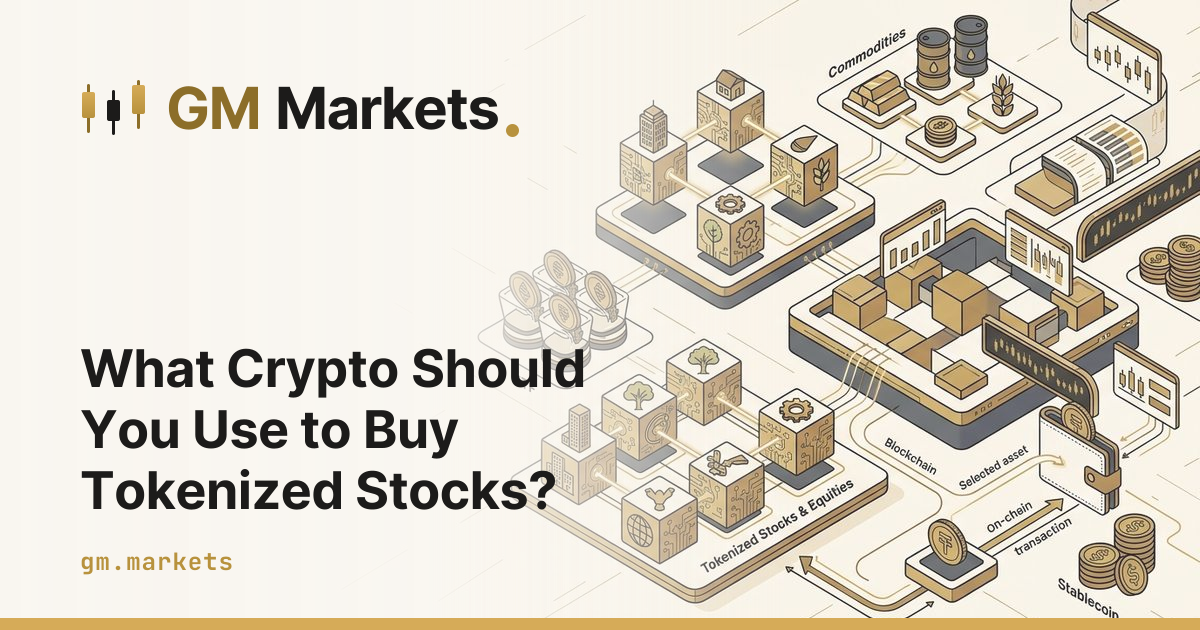
When converting crypto holdings into tokenized stock exposure, the most direct, cost-effective, and lowest-risk digital asset to use is a stablecoin, such as USDC or USDT. Using a volatile asset like Ether (ETH) or a native Layer 1 token introduces unnecessary price risk and potential tax complications into what should be a straightforward transaction. The goal is to gain exposure to an equity, not to speculate on the payment asset itself.
At GM Markets, we designed our platform around this principle. We believe that when you decide to buy a stock, your focus should be on the equity, not on the fluctuating value of your payment method. Our entire system, from our unified stablecoin balance to our gas abstraction model, is built to create a seamless bridge from your stablecoin holdings to the global stock market.
Key Criteria for Choosing a Crypto for Stock Purchases
To understand why stablecoins are the superior choice, it helps to evaluate the options against four critical factors: price stability, transaction costs, settlement speed, and platform acceptance.
- Price Stability: This is the most important factor. You need assurance that the value of the asset you use for payment will not decrease between the moment you initiate a trade and when it executes. Volatility in your payment asset adds a layer of risk that is unrelated to your actual investment thesis in the stock.
- Transaction Costs: Network fees, or gas, can significantly impact the total cost of your investment, especially for smaller or more frequent trades. Data from analytics platform growthepie shows that while Ethereum mainnet fees have decreased, Layer 2 networks offer dramatically lower costs. A standard token swap on an L2 like Arbitrum or Base can cost between $0.03 and $0.15, while the same action on mainnet could be $0.50 to $3.00 or more during periods of congestion. Choosing a crypto that operates efficiently on these low-cost networks is essential for preserving capital.
- Settlement Speed: The time it takes for a transaction to be confirmed on the blockchain can affect your ability to capture a specific market price. While Ethereum mainnet settlement is secure, it can be slower than Layer 2 networks, which often offer near-instant transaction finality. This is a critical feature for time-sensitive trades where capturing a price point is key.
- Platform Acceptance: The crypto you choose must be supported by the tokenized stock platform. Widespread acceptance and deep liquidity ensure that your asset can be easily used as a medium of exchange without incurring high slippage or requiring intermediate swaps, which add cost and complexity.
Why Stablecoins Are the Optimal Choice
Stablecoins excel across all key criteria, making them the ideal instrument for purchasing tokenized stocks.
First, and most importantly, they eliminate volatility risk. A stablecoin like USDC is designed to maintain a 1:1 peg with the U.S. dollar. This means that when you commit $100 of USDC to buy a stock, you can be confident that you are transferring exactly $100 of value. This removes the risk of your payment asset losing value during the transaction process, ensuring the cost basis of your investment is precise.
Second, stablecoins are natively integrated into the most cost-effective blockchain ecosystems. Both USDC and USDT are deeply liquid and widely available on low-fee chains like Base, Arbitrum, and Optimism, all of which we support on GM Markets. This allows you to fund your account and execute trades for a fraction of the cost of using Ethereum mainnet.
Finally, stablecoins function as the primary unit of account in the on-chain economy. With a combined market capitalization surpassing $257 billion as of July 2026, according to data compiled by Forbes, USDC and USDT are the most liquid and trusted mediums of exchange in the digital asset space. This is why major financial analysis firms view them as essential infrastructure. A 2026 Deloitte report, for example, explicitly identifies stablecoins as a "critical bridge between traditional cash, securities settlement and on chain markets." This reinforces their foundational role, a reliability we reflect in our own Proof of Reserves system.

The Disadvantages of Using Volatile Crypto (ETH, BTC, etc.)
Using a volatile cryptocurrency like ETH or WBTC to buy a tokenized stock introduces significant and unnecessary disadvantages. The primary issue is price risk on the payment asset itself. For example, if you place an order to buy $1,000 of tokenized TSLA using ETH, and the price of ETH drops by 2% before your order is filled, you have effectively paid $1,020 for your shares. This is an unforced financial error that stablecoins completely avoid.
Furthermore, this type of transaction creates tax complications in many jurisdictions. According to guidance from tax authorities like the U.S. Internal Revenue Service (IRS) and the U.K.'s HMRC, using one crypto asset to purchase another is often considered a taxable disposal. This means you could realize a capital gain or loss on the crypto you spent, creating a separate taxable event that you must track and report. This adds a layer of administrative burden on top of the financial risk.
How GM Markets Streamlines Buying Stocks with Stablecoins
We built GM Markets to eliminate these complexities. Our platform is optimized for stablecoins to provide the most efficient on-ramp to equity markets.
We use a system called USDF, a unified balance that automatically recognizes both USDC and USDT deposits from any supported chain. This means you can send either stablecoin from Base, Arbitrum, Optimism, or Ethereum, and it will appear in your single USDF balance, ready to trade. You do not need to worry about bridging or swapping assets between networks.
Our platform also features gas abstraction, a core part of our security and usability model. You never need to acquire or hold native network tokens like ETH or ARB to pay for transaction fees. We handle the network fees on your behalf and deduct the equivalent cost in USDF from your balance. This simplifies the user experience, allowing you to focus on your portfolio, not on managing multiple gas tokens.
The process is simple:
- Deposit USDC or USDT from a supported network to your GM Markets account.
- Your deposit is instantly credited to your unified USDF balance.
- Use your USDF balance to buy any tokenized stock or ETF with a single click.
Please note that our platform is in public beta and is not offered to users in the United States or other restricted jurisdictions. All trading involves risk, including the potential loss of principal. For more details, please review our risk and legal disclosures.
Frequently Asked Questions
Can I use Bitcoin to buy tokenized stocks on GM Markets?
No, we do not directly accept volatile crypto assets like Bitcoin or Ether for purchases. Our platform is standardized on stablecoins (USDC and USDT) to protect users from price volatility and simplify the transaction process. You would first need to convert your Bitcoin into a supported stablecoin on a separate exchange.
What are the fees for depositing stablecoins?
We do not charge any fees for depositing or withdrawing stablecoins. You only pay the standard network gas fee for the transaction on the blockchain you are using, which is typically very low on Layer 2 networks like Base and Arbitrum.
Do I need ETH in my wallet to pay for gas on Arbitrum or Base?
No. When using the GM Markets platform, our gas abstraction system pays the network fees for you. The equivalent cost is then deducted from your USDF balance, so you do not need to hold the native gas token of the network you are using.
How does using a stablecoin affect my tax reporting?
Using a stablecoin that is pegged 1:1 to the dollar generally simplifies tax reporting in many jurisdictions. Since its value does not fluctuate significantly, you typically do not realize a large capital gain or loss when you spend it. This can make calculating the cost basis of your stock purchase much more straightforward compared to using a volatile asset. However, you should always consult with a qualified tax professional regarding your specific circumstances.
Conclusion: Invest in Equities, Not in Transaction Fees
The most effective way to turn crypto holdings into equity exposure is by using a stable asset as the medium of exchange. Stablecoins like USDC and USDT provide the price stability, low transaction costs, and simplicity needed for efficient investing. They eliminate the unnecessary risks and complexities that come with using volatile cryptocurrencies for payment.
At GM Markets, we have built our platform to leverage these advantages, offering a direct and streamlined path from stablecoins to tokenized stocks. By unifying stablecoin deposits and abstracting away gas fees, we make accessing global equity markets from your on-chain wallet as simple as possible. To see our transparent fee structure, visit our pricing page.