Tokenized Stocks vs Traditional Stocks: A Complete Comparison
Explore a complete comparison of tokenized stocks vs. traditional stocks, covering ownership, settlement, custody, and investor protection to help you make informed investment decisions.
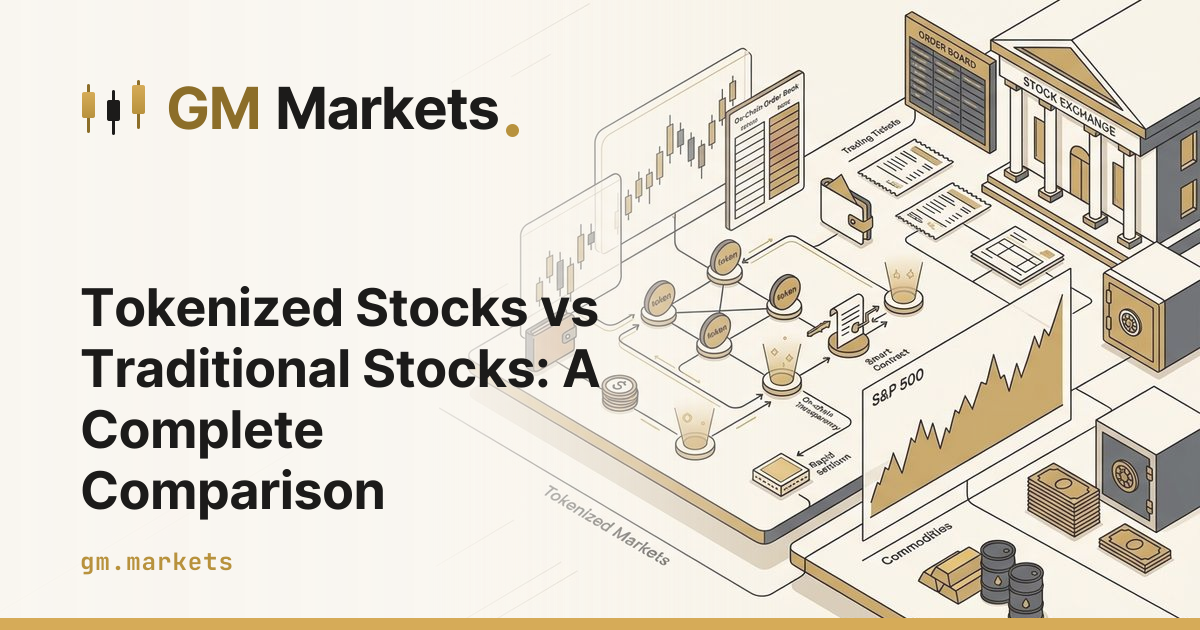
Tokenized Stocks vs Traditional Stocks: A Complete Comparison
The financial landscape is evolving, presenting investors with new ways to access global equity markets. For generations, traditional stocks have been the standard, representing units of ownership in a company, traded on centralized exchanges. Today, a modern alternative has emerged: tokenized stocks. These are blockchain-based representations of traditional equities, backed one-to-one by real shares. We understand that navigating these options requires clear information. Our purpose in this comparison is to highlight the distinct features, advantages, and considerations of both traditional and tokenized stocks. This will help investors seeking global equity exposure make informed decisions about which approach aligns best with their priorities. Please note: GM Markets does not offer services to users in the United States or other restricted jurisdictions.
The market for tokenized assets, particularly equities, is experiencing rapid growth. As of April 2026, the global tokenized asset market is estimated at approximately $17 billion. Projections are substantial, with the Citi Institute forecasting the global tokenized asset market to reach $5.5 trillion by 2030 in a base case, potentially reaching $8.2 trillion. Public market securities, especially U.S. equities, are expected to drive this growth, potentially constituting approximately $5.4 trillion of tokenized assets by 2030, making up about 66% of the total tokenized market. Other projections from institutions like Boston Consulting Group and Ark Invest also indicate significant growth, with estimates ranging from $11 trillion to $18.9 trillion by 2030-2033. While institutions currently hold a dominant share, retail investors are a fast-growing group in this evolving market.
Understanding Traditional Stocks and Their Framework
Traditional stocks represent a direct ownership stake in a company. When you buy a traditional stock, you typically do so through a licensed broker-dealer. This broker executes your order on a centralized stock exchange, such as the New York Stock Exchange or Nasdaq. After the trade is executed, it goes through a clearing and settlement process. This involves matching buyers and sellers, verifying the transaction, and transferring ownership of the shares and funds.
Historically, this settlement process took several business days. For instance, many markets operated on a T+2 cycle, meaning settlement occurred two business days after the trade. However, as of May 28, 2024, the United States, as mandated by the U.S. Securities and Exchange Commission (SEC), and Canada moved to a T+1 settlement cycle. Many European markets and the UK are planning a similar transition by October 2027, following recommendations from the European Securities and Markets Authority (ESMA) and the UK Government. Despite these efforts, cross-border trades can still face complexities due to varying settlement cycles and time zone differences.
Investor protection for traditional stock holdings in the United States relies on several mechanisms. The SEC Rule 15c3-3, also known as the Customer Protection Rule, mandates that broker-dealers segregate customer cash and securities from their own proprietary assets. This ensures that client funds are held separately. Additionally, the Securities Investor Protection Corporation (SIPC) provides protection for customer cash and securities up to $500,000 per customer, including a $250,000 limit for cash, in the event of a broker-dealer's financial failure. This protection covers missing assets, not losses due to market fluctuations.

Understanding Tokenized Stocks and How We Provide Them
Tokenized stocks are digital assets, typically ERC-20 tokens, that represent an economic claim on an underlying traditional share. On GM Markets, our tokenized stocks are fully backed one-to-one by actual US-listed shares or ETFs. These underlying shares are held in segregated customer accounts at regulated broker-dealers, specifically Interactive Brokers and Alpaca Markets, ensuring a direct link between the token and its real-world asset.
Transparency and verifiability are central to our model. We employ Accountable, a third-party proof-of-reserves provider, to attest broker balances directly and publish them on-chain in real time. This allows for independent verification of the one-to-one backing, providing a clear, auditable record of reserves against token supply on our Proof of Reserves page. Our platform is built on tokenization rails operated by Flo (flo.finance), and our smart contracts have been audited by firms including Sherlock, Halborn, Cantina, and Cyfrin, as detailed on our Security page.
When you trade on GM Markets, you access a permissionless, self-custodial platform. You can connect via an external wallet, Google, or an email magic-link. Our embedded wallets are operated by Privy using multi-party computation (MPC), meaning no single party, including GM Markets, holds the full private key. Trades settle on chains such as Base, Arbitrum, Ethereum, and Optimism. We abstract gas fees, billing the equivalent in USDF from your balance, so you never need to hold a native chain token. Our pricing model features a single trading fee of 10 to 20 basis points (0.10% to 0.20%), which drops as your 14-day trading volume grows through our VIP ladder. Deposits and withdrawals are free.

Direct Comparison: Traditional vs. Tokenized Stocks
Understanding the key differences between traditional and tokenized stocks is crucial for informed decision-making.
| Feature | Traditional Stocks | Tokenized Stocks (on GM Markets) |
|---|---|---|
| Ownership & Rights | Direct legal ownership of shares, including voting rights and other shareholder privileges. | Economic exposure to the underlying asset; token holders generally do not possess direct shareholder voting rights. |
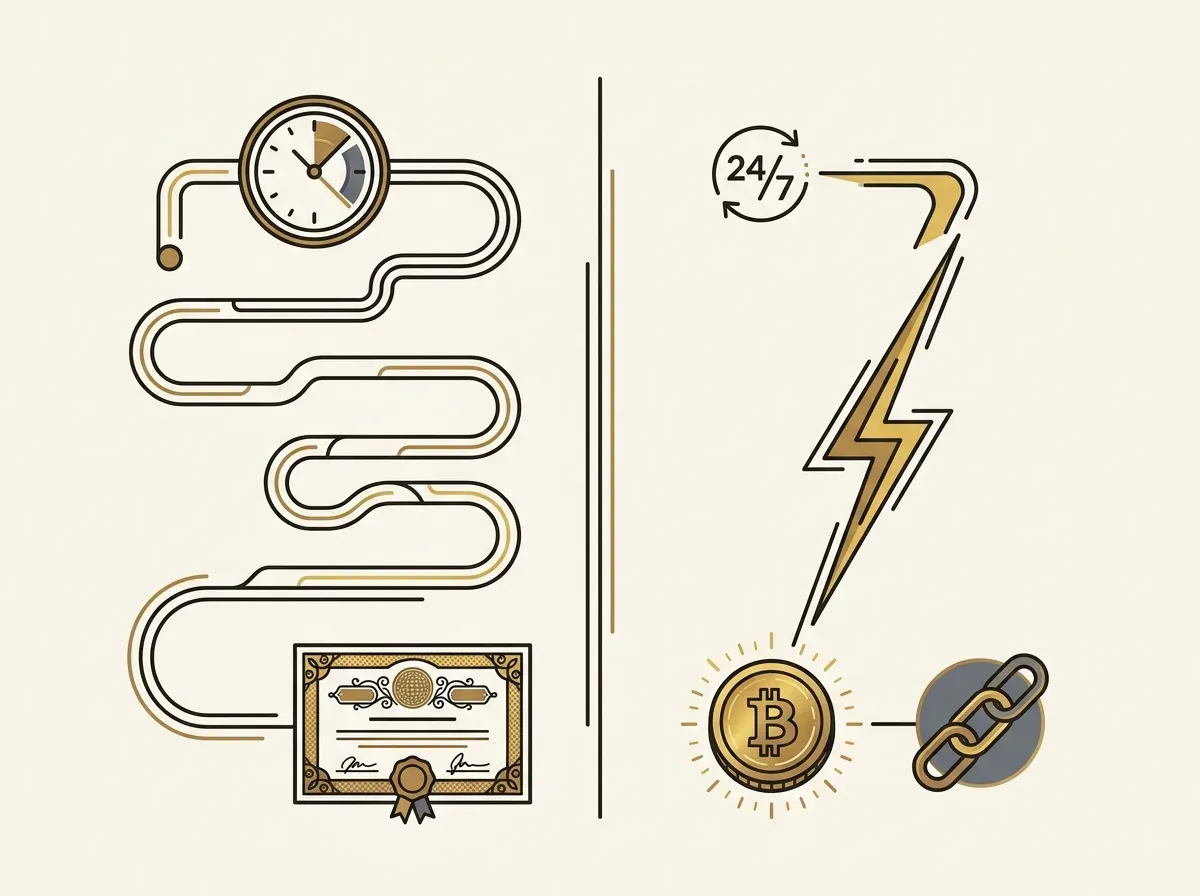
| Settlement | Typically T+1 in major markets (US, Canada, Mexico); T+2 or longer for cross-border trades. | On-chain settlement, often near-instantaneous or within minutes, depending on blockchain congestion. |
| Custody | Shares held by a broker-dealer in a brokerage account. | Tokens held in your self-custodial wallet (e.g., Privy MPC wallet), backed 1:1 by shares in segregated accounts at regulated broker-dealers. |
| Investor Protection | Subject to regulatory protections like SEC Rule 15c3-3 and SIPC insurance (in the US). | Backed by 1:1 reserves attested on-chain; redemption path enforced by smart contract. No direct SIPC-equivalent for the tokens themselves. |
| Accessibility | Access typically via traditional brokerage accounts, often with geographical restrictions. | Permissionless global access (outside restricted jurisdictions) via crypto wallets, with a $1 minimum trade. |
| Composability | Limited to traditional financial instruments and services. | ERC-20 tokens usable across DeFi protocols for lending, borrowing, and liquidity provision. |
| Trading Hours | Primarily during traditional market hours. | 24/7 trading availability; out-of-hours orders are queued on-chain. |
| Fees | May include trading commissions, custody fees, inactivity fees, and FX markups. | Single trading fee (10-20 bps); free deposits and withdrawals; no custody, inactivity, dividend, or FX fees. Gas abstracted. |
Important Considerations and Limitations of Tokenized Stocks
While tokenized stocks offer significant advantages in accessibility and composability, it is important to understand their limitations:
- No Direct Shareholder Voting Rights: Tokenized stocks typically provide economic exposure to the price movements and dividends (via NAV appreciation) of the underlying shares, but they generally do not confer direct shareholder voting rights. The issuer of the tokenized stock, not the token holder, usually holds the voting power of the underlying shares. While some emerging models allow for voting preferences, these are often advisory and not binding proxy votes.
- No Direct Legal Ownership: Holding a tokenized stock on platforms like ours provides economic exposure but does not constitute direct legal ownership of the underlying share in the same way a traditional brokerage account does.
- Dividend Treatment: On GM Markets, dividends from the underlying shares are reinvested to buy more of the underlying, which increases the token's on-chain Net Asset Value (NAV) rather than being paid out as a separate cash distribution. This is part of our total-return model.
- Regulatory Landscape and Investor Protection: The regulatory environment for tokenized assets is still evolving globally. While the underlying shares are held in regulated segregated accounts, the tokenized representations themselves may not fall under the same investor protection schemes (like SIPC in the US) that cover traditional brokerage accounts. Investors should be aware of the specific protections offered by the platform and its custodians.
- Smart Contract and Counterparty Risk: As blockchain-based assets, tokenized stocks are exposed to smart contract vulnerabilities. While our contracts are audited, no system is entirely risk-free. There is also counterparty risk associated with the market makers and custodians involved in the backing mechanism.
- Public Beta Status: GM Markets is currently in public beta. While core functionalities are robust and backed by 1:1 custody, some aspects of the platform are still evolving. We recommend trading with funds you are comfortable testing.
- Tax Reporting Complexity: Tax obligations for tokenized assets can be complex and vary by jurisdiction. While we provide CSV exports for your portfolio, you are responsible for understanding and fulfilling your own tax reporting requirements; consulting a tax advisor is recommended.
Frequently Asked Questions
What is the primary difference in ownership?
Traditional stocks represent direct legal ownership of a company's shares, granting shareholder rights. Tokenized stocks on GM Markets provide economic exposure to the value of underlying shares, which are held 1:1 in segregated accounts, but do not convey direct legal ownership or voting rights to the token holder.
Are tokenized stocks safer than traditional stocks?
Both traditional and tokenized stocks carry inherent market risks. Traditional stocks benefit from established regulatory frameworks and investor protections like SIPC in certain jurisdictions. Tokenized stocks offer transparency through on-chain proof of reserves and self-custody, but introduce smart contract and counterparty risks. The safety depends on the specific platform's architecture, custody model, and regulatory compliance.
Can I vote with my tokenized stocks?
No, tokenized stocks on GM Markets provide economic exposure to the underlying asset, including price movements and dividends (via NAV appreciation), but do not confer direct shareholder voting rights. The voting power of the underlying shares remains with the entity holding them in custody.
Accessing Global Equities with GM Markets
Whether you prioritize the established framework of traditional markets or the innovation and composability of tokenized assets, understanding these distinctions is key. GM Markets offers a modern approach to accessing global equities, providing a transparent, self-custodial, and efficient way to gain exposure to US-listed stocks and ETFs as on-chain tokens. We are committed to making global equity markets more accessible and composable for investors around the world (outside restricted jurisdictions).
Markets can move against you, and you may lose money. Tokenized stocks carry settlement, counterparty, smart-contract, and custody risks. We do not provide financial, investment, tax, or legal advice. For full details on risks and our legal framework, please visit our Legal page.