Tokenized Stocks vs. eToro: Which is Better for Buying US Stocks?
Compare tokenized stocks on GM Markets vs. eToro for buying US stocks. We analyze key differences in asset ownership, total costs, global access, and utility.
Two Paths to the Same Market
Both GM Markets and eToro offer global investors a way to gain exposure to popular US stocks like NVIDIA and Tesla. On the surface, they solve the same problem. Underneath, however, they are built on entirely different foundations. One operates on decentralized, on-chain principles, while the other uses traditional, centralized brokerage infrastructure. Understanding this distinction is critical for choosing the right platform.
This comparison examines the key differences between buying a tokenized stock on our platform and trading through a traditional online broker like eToro. We will analyze the models for asset ownership, total costs, global access, and what you can actually do with your assets after you buy them. This information will help you decide which approach best fits your investment strategy.
The Core Difference: Asset Ownership and Custody
The most fundamental difference lies in who truly owns and controls your assets. This distinction impacts everything from security to how you can use your capital.
On GM Markets, you buy a tokenized stock, which is a digital token that represents a 1:1 claim on a real share. We purchase and hold the underlying share in a segregated account at a regulated broker, and the token representing it is issued on-chain to your personal, self-custodial wallet. This means you have direct ownership and control over the token. It is a bearer instrument you can move, trade, or use across the digital economy without asking for permission.
On eToro, the model is custodial and varies by jurisdiction. For users in the UK and EU who open a non-leveraged position, eToro purchases the real share and holds it on their behalf in a pooled, omnibus account. You have a claim on the asset, but you do not have self-custody. For users in Australia, the structure is a managed investment scheme where you hold a beneficial interest, not direct legal title. In any jurisdiction, if you use leverage or open a short position, you are trading a Contract for Difference (CFD), which is a derivative that tracks the price without any ownership of the underlying asset at all.
Crucially, with eToro, your assets are locked within their platform. For clients outside the US, there is no mechanism to transfer your shares to another broker. You must sell your position to cash, withdraw the funds, and then repurchase the asset elsewhere. This contrasts directly with the on-chain ownership model, where you control the asset in your own wallet.

A True Cost Comparison: Beyond Commission-Free Marketing
Many online brokers market themselves as “zero commission,” but this often hides other fees. A transparent cost structure is essential for understanding your net returns.
Our pricing model at GM Markets is simple. We charge one transparent trading fee that ranges from 10 to 20 basis points (0.10% to 0.20%), which is included in the price you are quoted. There are no fees for deposits or withdrawals, no currency conversion markups, and no inactivity penalties. You can find a full breakdown on our pricing page.
eToro’s costs are more complex. While they do not charge a commission for many stock trades, fees appear in other areas:
- Currency Conversion Fees: If you fund your account with a currency other than USD, like EUR, you will pay a conversion fee. This fee can be as high as 1.5% on deposits and is also applied when converting funds to buy US-listed stocks.
- Withdrawal Fees: A flat fee of $5 is charged for all withdrawals from USD-denominated accounts.
- Inactivity Fees: An account that has not been logged into for 12 months is charged a $10 monthly inactivity fee.
- Bid-Ask Spread: Like all brokers, eToro makes money on the spread between the buy and sell price, which is a variable and less transparent cost.
These ancillary fees can accumulate and significantly impact the total cost of trading, especially for active investors or those dealing with multiple currencies.
Global Access and Onboarding
How you access a platform determines how quickly and easily you can enter the market. Our approach prioritizes open, permissionless access for a global audience. You can connect to GM Markets with an existing crypto wallet, a Google account, or an email address, with no lengthy verification process for getting started. We are designed to serve a global user base. Please note that our platform is not offered to users in the United States or other restricted jurisdictions.
eToro follows a traditional onboarding path. It requires a multi-step Know Your Customer (KYC) process, where you must submit identity documents and proof of address for verification. This process is standard for regulated financial institutions but creates friction for users. Furthermore, eToro’s services are explicitly unavailable in many countries, including Canada, China, Japan, Turkey, and India, limiting access for a large portion of the global population.

Asset Utility: What You Can Do After You Buy
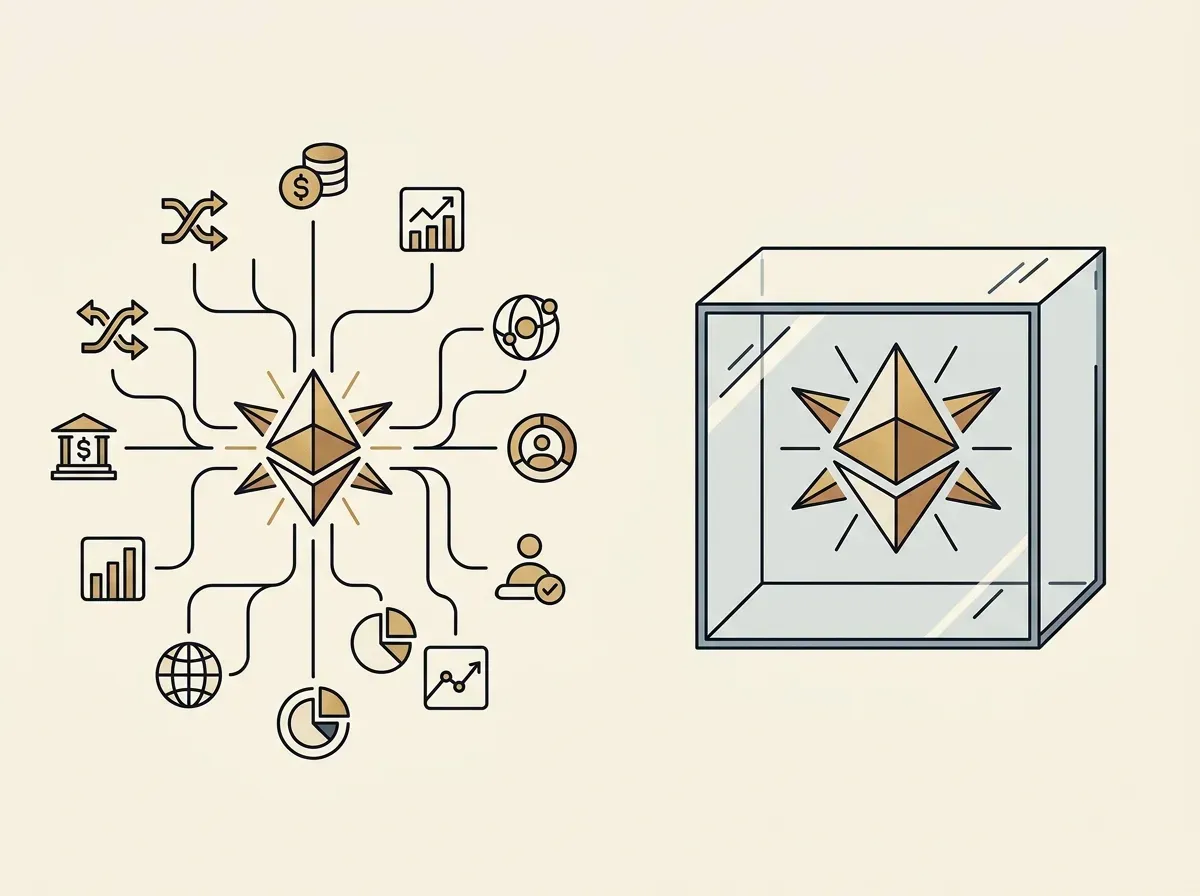
A critical question for any investor is what they can do with their asset once it is in their portfolio. On GM Markets, our tokenized stocks are standard ERC-20 tokens on networks like Base and Arbitrum. This makes them fully composable within the world of decentralized finance (DeFi). You can use your tokenized NVIDIA stock as collateral to take out a loan on Aave or Morpho, supply it to a liquidity pool on Uniswap to earn fees, or deploy it in various other yield-generating strategies. Your stock becomes a productive piece of capital, not just a static holding.
With eToro, your assets are confined to their closed ecosystem. You can hold your position or sell it. There is no way to withdraw your shares to an external wallet or use them in any other financial application. The utility of your asset is limited to price exposure within the confines of the eToro platform.
Security and Trust: On-Chain Transparency vs. Regulation
Both models offer robust but different approaches to security and trust. Your preference will depend on whether you place more trust in cryptographic proof or in traditional regulatory frameworks.
The GM Markets trust model is based on verifiable, on-chain transparency. Every token we issue is backed 1:1 by a real share held with our custodian brokers. You can verify this for yourself, 24/7, on our Proof of Reserves page, which shows the real-time supply of tokens against the attested shares held in custody. Our security is further supported by third-party smart contract audits and the non-custodial nature of your wallet. You can learn more on our security page.
eToro’s trust model is based on its status as a regulated entity. In the UK, it is regulated by the Financial Conduct Authority (FCA), and in Europe by the Cyprus Securities and Exchange Commission (CySEC). This provides certain protections, such as investor compensation schemes. For example, UK clients are covered by the Financial Services Compensation Scheme (FSCS) for up to £85,000, while EU clients have coverage up to €20,000 under the Investor Compensation Fund (ICF). This is a traditional, legal-agreement-based model of trust.
Conclusion: Choosing the Right Model for Your Goals
Ultimately, the choice between tokenized stocks and a traditional broker like eToro depends on your priorities as an investor. eToro offers a conventional, regulated, and contained experience that may feel familiar to those accustomed to traditional finance. It provides a simple way to gain price exposure within a closed system.
GM Markets represents a modern, on-chain, and open alternative centered on true asset ownership, lower total costs, and greater capital efficiency. If you see your stocks not just as static holdings but as dynamic assets that can be integrated into the broader digital economy, the tokenized model offers fundamentally more power and flexibility.
All investments carry risk, and the value of stocks can go down as well as up. Tokenized assets also involve specific risks related to smart contracts, settlement, and custody. We do not provide financial advice. For more information, please review our legal and risk disclosures. If you believe in the power of self-custody and on-chain finance, you can start exploring tokenized US stocks on our platform today.