Tokenized Stocks vs. Crypto: A Guide to On-Chain Assets
Explore the key differences between tokenized stocks and cryptocurrencies. Learn how they differ in backing, value, volatility, and regulation, and see how both fit into the on-chain asset ecosystem.
Two Asset Classes, One Technology
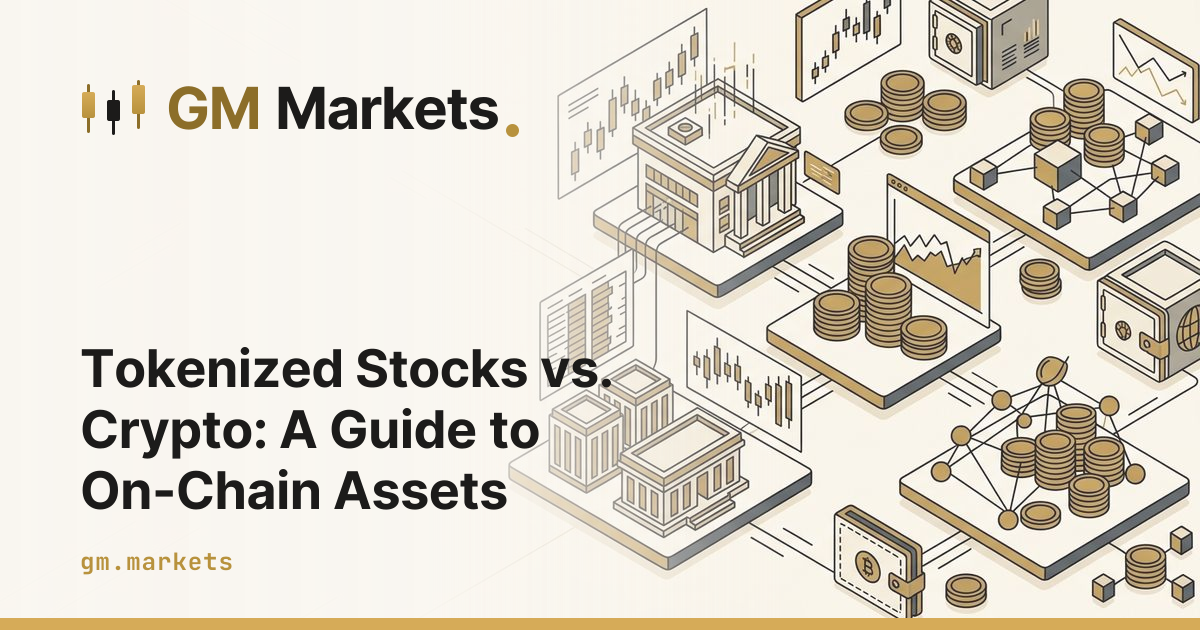
Investors exploring on-chain assets often encounter two distinct categories: tokenized stocks and cryptocurrencies. While both use blockchain technology for issuance and settlement, their fundamental difference lies in their source of value and risk. The key distinction is what the token represents. A cryptocurrency is a native digital asset whose value derives from its network protocol and code. A tokenized stock is a digital representation whose value is directly tied to, and backed by, an underlying real-world financial security.
Understanding this difference is critical for navigating the digital asset landscape. Cryptocurrencies like Bitcoin and Ethereum represent a new, self-contained digital economy. Tokenized stocks, on the other hand, use blockchain as a rail to make traditional financial assets more efficient, accessible, and composable. On our platform, we specialize in this second category, bridging the worlds of traditional finance and on-chain technology by issuing tokens fully backed by publicly traded securities.
What Is a Tokenized Stock?
A tokenized stock is a digital token that represents ownership of one share of a publicly traded company. For every tokenized share of NVDA or TSLA available on GM Markets, we hold one corresponding share of the actual stock in a segregated account at a regulated broker-dealer, such as Interactive Brokers or Alpaca Markets. This 1:1 backing is the foundation of the token's value.
The token's price directly tracks the market price of the underlying stock. When the company pays a dividend, we use the proceeds to purchase more of the underlying shares, which increases the token's Net Asset Value (NAV). This total-return model ensures your tokenized position captures the full economic value of the stock. You can verify the 1:1 backing of our assets at any time through our Proof of Reserves page, which shows real-time, on-chain attestations from a third-party auditor.
This structure is part of a rapidly growing market for Real-World Assets (RWAs). Major financial analysts project significant growth, with Boston Consulting Group forecasting a $16 trillion opportunity by 2030. Tokenized stocks are a primary component of this trend, bringing established assets into the on-chain ecosystem.
What Is a Cryptocurrency?
A cryptocurrency is a native digital asset secured by cryptography. Unlike a tokenized stock, its value is not derived from an external, off-chain asset. Instead, its value comes from a combination of factors inherent to its own digital ecosystem. These can include:
- Network Effects: The value increases as more people use and accept the currency.
- Scarcity: The total supply is often fixed by the protocol's code, as with Bitcoin's 21 million coin limit.
- Utility: The token may be required to access services on a network. For example, Ethereum's token, ETH, is used to pay for transaction fees (gas) and computation within its ecosystem of decentralized applications.
- Community Consensus: A decentralized network of participants collectively agrees on the asset's validity and history.
The security and issuance of cryptocurrencies are managed by their underlying blockchain. For instance, in a Proof-of-Stake system like Ethereum, participants known as validators lock up, or "stake," their own crypto to propose and validate new blocks of transactions. In return for securing the network, they receive staking rewards, which consist of newly issued ETH and transaction fees. This entire system is self-contained and does not rely on a traditional custodian or underlying asset for its operation.

Key Differences at a Glance
While both asset types exist on a blockchain, their core characteristics are fundamentally different. The following table provides a direct comparison.
| Feature | Tokenized Stocks | Cryptocurrencies |
|---|---|---|
| Underlying Value & Backing | Backed 1:1 by a real-world share held in custody at a regulated broker. Value is derived from the underlying company's performance. | Not backed by an external asset. Value is derived from network consensus, scarcity defined in code, and utility. |
| Source of Volatility | Tied to corporate earnings, market sentiment, and economic data. Primarily trades during traditional market hours. Volatility is generally lower, similar to the S&P 500's 90-day realized volatility of around 15-20%. | Driven by 24/7 crypto market dynamics, technological developments, and speculative sentiment. Volatility is historically higher, with Bitcoin's 90-day realized volatility often 3 to 4 times that of major stock indices. |
| Regulation | The underlying asset is a regulated security. Regulators like the U.S. SEC and ESMA in Europe have clarified that tokenizing a security does not change its legal status; it remains subject to securities laws. | Operates under an evolving and jurisdiction-specific regulatory framework. Some jurisdictions have created bespoke rules like the EU's Markets in Crypto-Assets (MiCA) regulation. |
| Income Generation | Dividends paid by the underlying company are automatically reinvested, increasing the token's Net Asset Value (NAV). | Staking rewards, transaction fees paid to validators, or protocol-defined inflation. |
| Issuance | A new token is minted only when one real share is deposited into custody. A token is burned when the underlying share is redeemed. | New coins are created through mining (Proof-of-Work) or as rewards for staking (Proof-of-Stake) according to a schedule defined in the protocol. |
Composability: The Shared Advantage
Despite their differences, tokenized stocks and cryptocurrencies share one powerful feature because they are both blockchain-based: composability. Because our tokenized stocks are issued as standard ERC-20 tokens, they can interact seamlessly with the broader ecosystem of Decentralized Finance (DeFi). This means an asset that was previously locked in a traditional brokerage account can now be used as productive capital on-chain.
You can use a tokenized stock from our platform as collateral to borrow other assets in a lending protocol, supply it to a liquidity pool on a decentralized exchange, or use it for margin trading. For example, DeFi lending markets like Venus Protocol have already begun integrating tokenized stocks as a form of collateral, allowing users to borrow stablecoins against their equity positions without selling them. This is the core innovation we enable: bringing the collateral quality and established value of traditional assets to the permissionless world of DeFi.

Choosing the Right On-Chain Asset for You
This article does not provide financial advice. Its purpose is to inform you about the distinct characteristics of different on-chain assets. Tokenized stocks offer exposure to the traditional global economy, backed by regulated securities, with the modern benefits of on-chain settlement and transparency. They may appeal to investors who want to integrate traditional asset classes into their on-chain strategy.
Cryptocurrencies offer exposure to a new, self-contained digital economy driven by decentralized technology and network effects. They represent a fundamentally new type of asset class with its own risk and return profile.
All trading and investment activities involve risk. The value of both tokenized stocks and cryptocurrencies can fall as well as rise, and you may lose the money you put in. Tokenized assets carry specific risks, including smart contract risk, counterparty risk with custodians and market makers, and market volatility. Please review our full risk disclosures before trading. Our platform is not offered to users in the United States or other restricted jurisdictions.
Frequently Asked Questions
Do tokenized stocks grant shareholder voting rights?
No. Our tokenized stocks are designed to provide full economic exposure to the underlying share, including price movements and dividends. They do not, however, confer the voting rights that come with direct share ownership. The focus is on financial representation, not corporate governance.
Are tokenized stocks regulated differently from crypto?
Yes. Global regulators have been clear that if the underlying asset is a security, the token representing it is also treated as a security. This means tokenized stocks fall under existing securities laws, while native cryptocurrencies are subject to a separate and still-developing regulatory framework.
Can a tokenized stock's price differ from the actual stock's price?
The price of our tokenized stocks is designed to track the underlying asset very closely. We use a Request-For-Quote (RFQ) system where regulated market makers provide real-time prices based on the live stock market. While minor deviations can occur, arbitrage opportunities generally ensure the token's price remains tightly aligned with the stock's price.
Conclusion: The Future of Asset Representation
Tokenized stocks and cryptocurrencies are distinct asset classes that utilize the same underlying blockchain technology. Cryptocurrencies are new, native digital assets, while tokenized stocks are digital wrappers for existing, regulated financial instruments. By representing real-world securities on-chain, tokenized stocks offer a regulated, asset-backed bridge that combines the stability of traditional markets with the efficiency and composability of DeFi. This allows you to put established assets to work in new ways. You can explore the available tokenized stocks and ETFs on our platform to see how this technology works in practice.