Tokenized Stocks vs. Crypto: A Complete Comparison for Investors
Explore the key differences between tokenized stocks and cryptocurrencies. This guide compares their source of value, risk profiles, regulatory treatment, and DeFi use cases.
Tokenized Stocks vs. Crypto: A Complete Comparison for Investors
Investors exploring digital assets often encounter two distinct categories: tokenized stocks and cryptocurrencies. While both use blockchain technology for issuance and transfer, they are fundamentally different assets with separate value propositions, risk profiles, and regulatory treatments. A tokenized stock derives its value directly from a share in a real-world company, making it an extrinsic, asset-backed instrument. A cryptocurrency’s value is native to its digital protocol, making it an intrinsic, protocol-dependent asset. Understanding this core distinction is critical for making informed decisions.
At GM Markets, we specialize in providing access to tokenized U.S. stocks, and this article offers a direct, evidence-based comparison to help you understand the specific characteristics of each asset class. We will explain how each asset derives its value, its typical volatility, its standing with global regulators, and its unique role within the decentralized finance (DeFi) ecosystem. This comparison is grounded in verifiable data and official sources to provide a clear and accurate picture.
What Are Tokenized Stocks?
A tokenized stock is a digital representation of one share of a publicly traded company, such as Apple (AAPL) or NVIDIA (NVDA), that is issued and managed on a blockchain. The foundational principle is 1:1 backing. For every token that exists on-chain, one corresponding share of the actual stock is purchased and held in a segregated account at a regulated custodian. On our platform, we use established broker-dealers like Interactive Brokers and Alpaca Markets for this purpose.
The value of a tokenized stock is directly and continuously tied to the live market price of the underlying share on its primary exchange, for example, the NASDAQ or NYSE. If the price of one share of Tesla is $180, the price of one tokenized TSLA is also $180. This relationship is not based on trust alone; it is verifiable through our on-chain Proof of Reserves system. This system allows anyone to see the total supply of tokens issued versus the attested balance of shares held by our brokerage partners in real time, confirming the 1:1 backing ratio.
Economic benefits from the underlying stock, such as dividends and stock splits, are also passed to the token holder. We use a total-return model for this. When a company pays a dividend, the proceeds are used to purchase more of the underlying asset. This purchase increases the total value of the asset pool, which in turn increases the net asset value (NAV) of each token. Corporate actions like stock splits are handled automatically to maintain the total value of an investor's position. For example, during NVIDIA's 10-for-1 stock split in June 2024, token holders saw their token balance multiply by ten, with the price per token adjusting downward proportionally, ensuring no economic value was lost.

What Are Cryptocurrencies?
A cryptocurrency is a native digital asset, such as Bitcoin (BTC) or Ether (ETH), secured by cryptography that exists only on its own blockchain. Unlike tokenized stocks, cryptocurrencies are not backed by any underlying physical or financial asset. Their value is intrinsic to their network protocol and the ecosystem built around it. They represent a new form of digital value, secured by decentralized consensus among network participants.
The value of a cryptocurrency is derived from a combination of specific, digitally native factors:
- Scarcity: The total supply is often algorithmically limited by the protocol's code. Bitcoin, for example, has a fixed supply of 21 million coins that can ever be created, a rule enforced by its software.
- Network Effects: The value tends to increase as more users, developers, and applications join the network. Ethereum's value, for instance, is closely linked to the vast ecosystem of decentralized applications (dApps), DeFi protocols, and NFTs built upon it.
- Utility: The token is often required to perform actions within its ecosystem. Ether is used to pay for transaction fees, known as gas, on the Ethereum network, creating constant demand for the asset to facilitate network operations.
- Community Consensus: The collective belief and agreement among participants about the asset's value, purpose, and future direction play a significant role. This is maintained through governance mechanisms and the shared economic incentives of miners, stakers, and users.
The issuance of new cryptocurrency is governed entirely by the protocol itself, through mechanisms like mining rewards (Proof-of-Work) or staking rewards (Proof-of-Stake), and is not connected to any external company's performance or asset valuation.
Key Differences: A Head-to-Head Comparison
While both asset classes use the same underlying technology, their fundamental characteristics create distinct profiles for investors. Here, we break down the most important differences in detail.
Source of Value: Extrinsic vs. Intrinsic
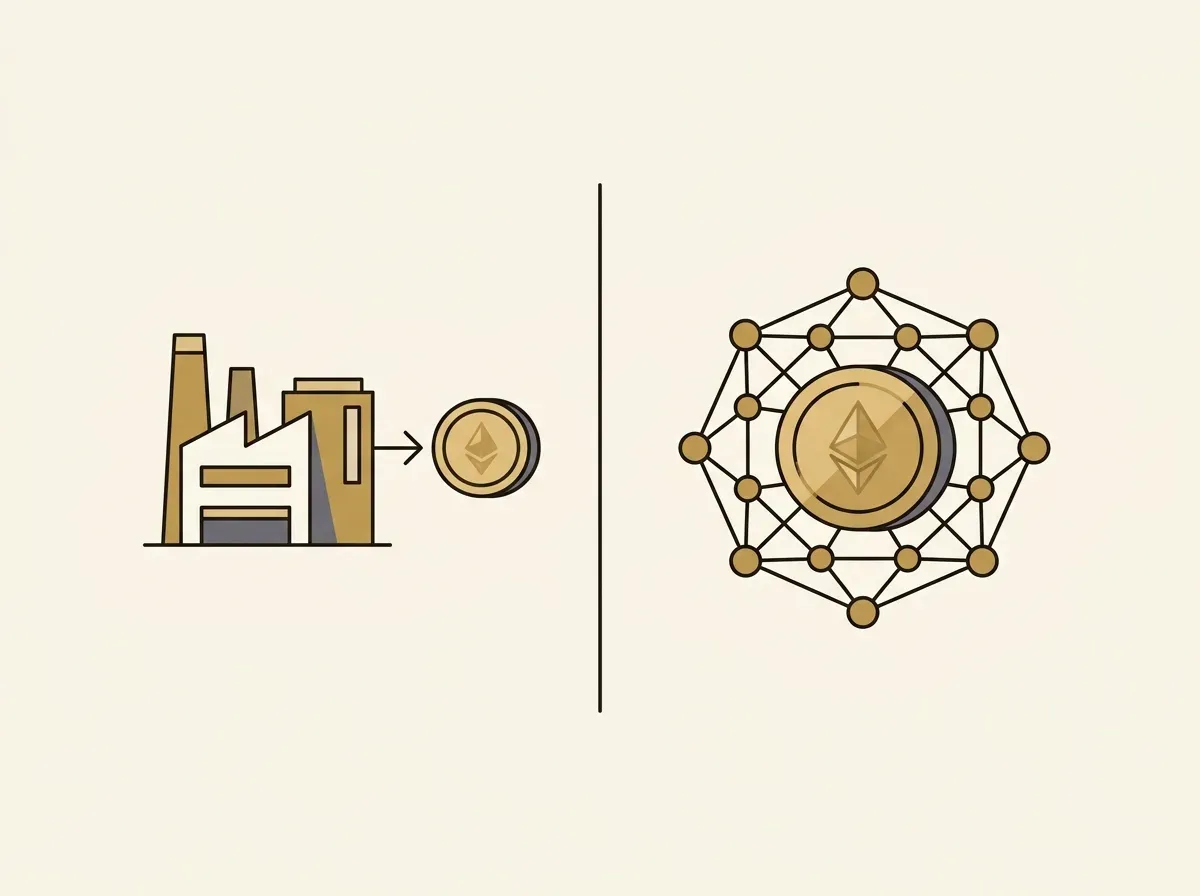
A tokenized stock has an extrinsic source of value. Its price is determined by factors external to the blockchain: the underlying company’s financial performance, earnings reports, industry trends, and broader macroeconomic conditions. The token is a derivative instrument, a pass-through vehicle for the value of a traditional security.
A cryptocurrency has an intrinsic source of value. Its price is determined by factors native to its own digital ecosystem: the security and decentralization of its network, the utility of its token, the rate of user adoption, and the sentiment of the on-chain community. Its value is self-contained within its protocol and network.
Risk and Volatility Profile
Tokenized stocks inherit the market risk and volatility of the underlying equity. While individual stocks can be volatile, major market indices provide a useful benchmark. According to long-term analysis from Crestmont Research, the S&P 500's volatility has historically averaged around 15%, with most periods falling within a 10% to 20% band. In addition to this market risk, tokenized assets also carry technical risks, such as smart contract vulnerabilities and platform counterparty risk.
Cryptocurrencies have historically exhibited higher volatility, driven by rapid shifts in market sentiment, regulatory news, and protocol developments. However, this is also evolving. A May 2024 report from Fidelity Digital Assets found that Bitcoin's average 90-day realized volatility was 46% over the preceding two years. While higher than the S&P 500, the report noted this was less volatile than 92 individual stocks within the S&P 500, challenging simple narratives about its risk profile.
Regulatory Framework
Tokenized stocks are generally treated as securities by regulators worldwide. This is based on the principle of 'substance over form', where the regulatory treatment is determined by the economic reality of the asset, not the technology used to represent it. In the United States, the SEC has provided guidance clarifying that if a digital asset has the features of a security, it is subject to federal securities laws. Similarly, the European Union established Regulation (EU) 2022/858, the DLT Pilot Regime, to create a legal framework for the trading and settlement of tokenized financial instruments.
The regulatory landscape for cryptocurrencies is newer and still developing. These assets often fall outside of traditional securities definitions. As a result, new frameworks are being created specifically for them, such as the EU's Markets in Crypto-Assets (MiCA) Regulation, which aims to govern crypto-assets not already covered by existing financial services legislation.
Use Case in DeFi and Composability
A primary innovation of tokenized stocks is their ability to bridge traditional finance (TradFi) and DeFi. They allow real-world equity exposure to be used as programmable, on-chain collateral. This unlocks new forms of capital efficiency. For example, the Solana-based lending protocol Kamino Finance now accepts tokenized stocks as collateral, allowing users to borrow stablecoins against their equity holdings. Similarly, the Ethereum-based lending protocol Morpho has integrated tokenized ETFs, enabling holders to use these assets productively within DeFi.
Cryptocurrencies are the native collateral and foundational layer for the vast majority of DeFi applications. Assets like ETH and wrapped BTC (wBTC) are the primary assets used for lending, borrowing, and providing liquidity on decentralized exchanges, forming the bedrock of the entire on-chain economy.
Trading Tokenized Stocks on GM Markets
Our platform is designed to make global equity markets accessible through the efficiency and transparency of blockchain technology. We provide a direct way to gain economic exposure to tokenized U.S. stocks, reducing the friction often associated with traditional international brokerages. You can trade fractional shares from as little as $1, access deep liquidity for many assets 24/7, and benefit from instant settlement on secure L2 blockchains like Base and Arbitrum. Our pricing model is simple: a single trading fee from 0.10% to 0.20%, with no deposit, withdrawal, or custody fees.
Please note that our services are not offered to users in the United States or other restricted jurisdictions.
The security of your assets is our highest priority. Our model is built on the foundation of 1:1 backing, with real-time third-party attestation from Accountable and the use of regulated, established custodians for all underlying shares. It is important to understand the risks involved. Tokenized stocks carry the market risk of the underlying shares, meaning their value can decrease as well as increase. They also involve risks specific to digital assets, including those associated with smart contracts, custody, and counterparties. This article is for informational purposes only and does not constitute financial advice. For more details, please review our risk and legal disclosures.
Frequently Asked Questions
What determines the value of a tokenized stock vs. a cryptocurrency?
The value of a tokenized stock is determined by the market price of its underlying share on a traditional stock exchange, reflecting the company's performance and investor sentiment. The value of a cryptocurrency is determined by supply and demand dynamics native to its digital ecosystem, including its utility, scarcity, and the overall health of its network.
Are tokenized stocks safer than cryptocurrencies?
They have different risk profiles rather than one being universally safer. Tokenized stocks are subject to the market risks of the traditional companies they represent, plus technical risks like smart contract vulnerabilities. Cryptocurrencies have risks related to protocol security, market sentiment, and evolving regulations, and have historically shown higher price volatility.
How are dividends handled with tokenized stocks?
On our platform, dividends are handled through a total-return model. When a company pays a dividend, the funds are used to purchase more of the underlying stock. This action increases the net asset value (NAV) of your token, so you see the value of the dividend reflected directly in the price of your asset.
Do I get voting rights with tokenized stocks?
No, holding a tokenized stock provides you with economic exposure to the underlying share, including its price movements and dividends. It does not, however, confer the shareholder voting rights that come with direct ownership of the stock on a company's register.
Can I use tokenized stocks in DeFi?
Yes, composability is a key feature. Tokenized stocks are typically issued as standard ERC-20 tokens that can be used as collateral in DeFi lending protocols, supplied as liquidity, or integrated into other on-chain applications. Platforms like Morpho and Kamino have already integrated tokenized ETFs as collateral, allowing users to borrow against their equity positions.
Conclusion: Choosing the Right Digital Asset
Tokenized stocks and cryptocurrencies both leverage blockchain technology, but they serve fundamentally different purposes in an investment portfolio. Tokenized stocks offer a technologically advanced way to access the established value and regulatory clarity of traditional equity markets. Cryptocurrencies offer exposure to a new, digitally native asset class with a unique risk-and-return profile driven by protocol innovation and network adoption. By understanding these core distinctions, you can better evaluate how each asset aligns with your own financial goals.
Sources
- ballardspahr.com
- bakerdonelson.com
- perkinscoie.com
- stinson.com
- regulatoryandcompliance.com
- sullcrom.com
- aoshearman.com
- eco.com
- europa.eu
- ilpabogados.com
- cryptoverselawyers.io
- goodwinlaw.com
- regulationtomorrow.com
- europa.eu
- aoshearman.com
- bitcoinmagazine.com
- binance.com
- hashcodex.com
- wordpress.com
- tokenizer.estate
- binance.com
- coingeek.com
- elliptic.co
- businessinsider.com
- thebusinessofmoney.co.za
- binance.com
- rootdata.com
- theblock.co
- pointsville.com
- bitget.com
- bitget.com
- bitget.com
- fastcompany.com
- capital.com
- moomoo.com
- bitcoin.com
- bitget.com
- bitget.com
- fidelitydigitalassets.com
- crestmontresearch.com
- alphaquery.com
- alphaquery.com
- nyu.edu
- quora.com
- sec.gov
- sewkis.com
- aoshearman.com
- morganlewis.com
- katten.com
- statestreet.com
- sec.gov
- clearygottlieb.com
- dfinsolutions.com
- europa.eu
- dlapiper.com
- europa.eu
- goodwinlaw.com
- europa.eu
- dlapiper.com
- europa.eu
- afg.asso.fr
- europa.eu
- europa.eu
- thedefiant.io
- theblock.co
- kamino.finance
- tokenterminal.com
- morpho.org
- medium.com
- cryptocompare.com
- morpho.org
- kamino.finance
- solanacompass.com