Tokenized Stocks Explained: How On-Chain Equities Work
A tokenized stock is a digital token on a blockchain representing a 1-to-1 claim on a real share. Learn how they work, their advantages over traditional stocks, and the risks involved.
What Is a Tokenized Stock?
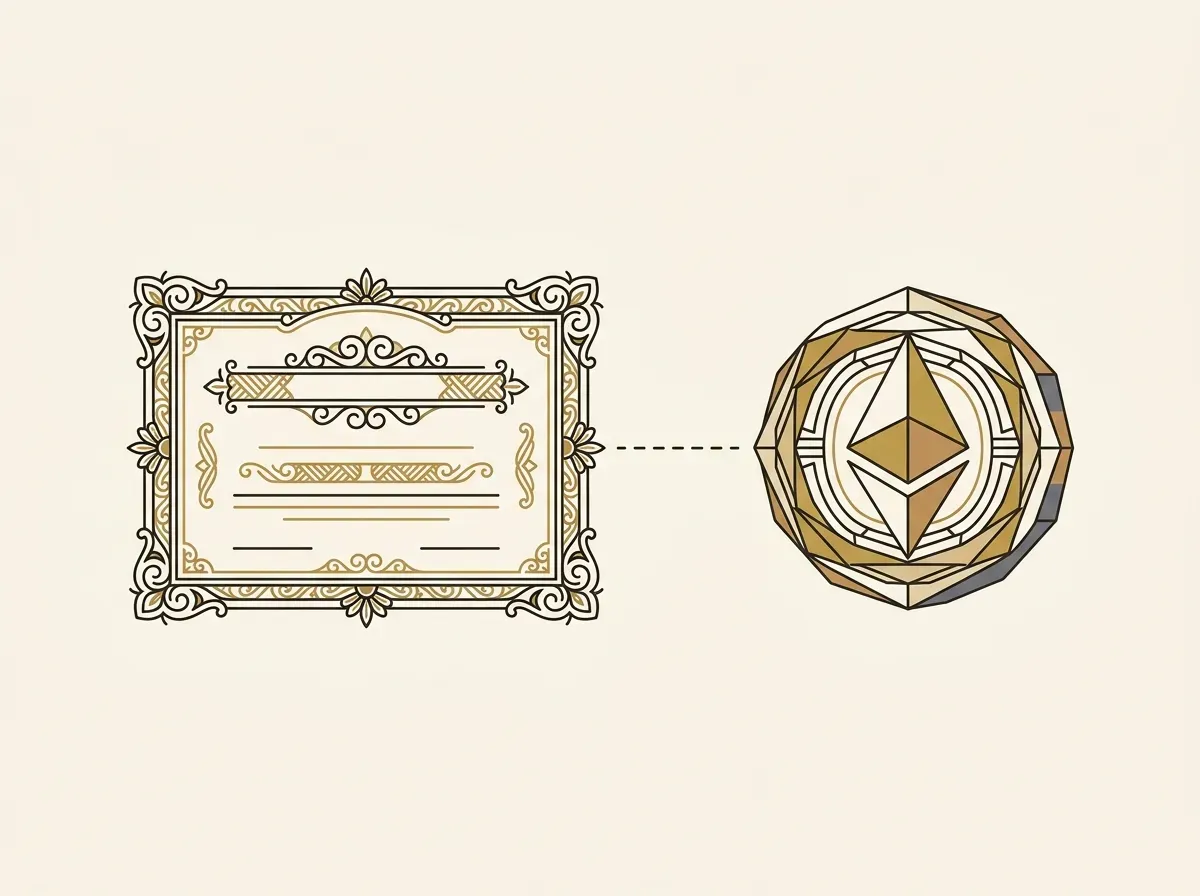
A tokenized stock is a digital token issued on a blockchain that represents a direct, 1-to-1 claim on a share of a publicly traded company. For every tokenized share of a company like NVIDIA that exists on-chain, one actual share of NVDA is purchased and held in a segregated custody account at a regulated broker. This model ensures each token is fully backed by the real-world asset it represents.
This differs significantly from how shares are typically held in a traditional brokerage account. Most retail investors hold securities in what is known as “street name,” where the brokerage firm is the registered owner, and the investor is the “beneficial owner.” While you have rights to the value of the asset, you do not directly possess it. Tokenized stocks, in contrast, are standard crypto assets, like ERC-20 tokens on chains such as Base or Arbitrum. They live directly in your self-custodied wallet, giving you direct control and ownership of the digital representation of your asset.
The market for tokenizing real-world assets is expanding rapidly, with major financial institutions like BlackRock and JPMorgan investing heavily in the technology. A report from Boston Consulting Group projected the market for tokenized assets could reach $16.1 trillion by 2030, highlighting the institutional shift toward this new financial infrastructure.
How 1:1 Backing and Proof of Reserves Work
The security and value of a tokenized stock depend entirely on the integrity of its backing. The process is designed for transparency and verifiability, ensuring that the on-chain supply of tokens never exceeds the supply of real shares held in custody.
Here is how the mechanism functions on our platform:
- Asset Purchase: When you purchase a tokenized stock, a corresponding real share is bought on the public market and deposited into a segregated customer account at a regulated, third-party broker-dealer, such as Interactive Brokers or Alpaca Markets.
- Segregated Custody: These shares are held in accounts that are legally separate from the assets of the broker or GM Markets. This structure protects your assets in the event of insolvency of either entity.
- Token Minting: For each share held in custody, one token is created (minted) on the blockchain and sent to your wallet. This maintains a strict 1-to-1 backing ratio at all times. The reverse happens when you sell: your token is burned, and the underlying share is sold from the custody account.
- Real-Time Attestation: To provide verifiable proof of this backing, we use a third-party service, Accountable, for on-chain proof of reserves. Accountable has permission to read the balances in our brokerage accounts and continuously publishes the number of shares held for each asset directly to the blockchain. You can visit our Proof of Reserves page at any time to see the live, independently attested data showing that every token is fully backed.
Key Advantages Over Traditional Stocks
Combining equity ownership with blockchain technology creates several distinct advantages for global investors.
Global Accessibility
For investors outside the United States, accessing US equities can involve high fees, complex onboarding, and regional restrictions. Tokenized stocks remove many of these barriers, allowing anyone with an internet connection and a crypto wallet to gain economic exposure to US-listed companies. Please note that our services are not offered to users in the United States or other restricted jurisdictions.
Self-Custody and Control
With tokenized stocks, you hold the asset directly in your own wallet. This reduces the counterparty risk associated with a traditional broker holding your shares on your behalf. You have full control to move, trade, or use your assets 24/7 without needing permission from an intermediary.
DeFi Composability
Because they are standard on-chain tokens, tokenized stocks can be integrated directly into the decentralized finance (DeFi) ecosystem. This unlocks powerful new capabilities that are impossible with shares held in a traditional brokerage account. You can use your tokenized stock position as collateral to borrow stablecoins, supply it to a liquidity pool to earn trading fees, or use it in other advanced financial strategies.
Fractional Ownership
Many high-growth stocks trade for hundreds or thousands of dollars per share, making it difficult for some investors to build a diversified portfolio. Tokenization allows for ownership to be divided into millions of fractional units. On GM Markets, you can buy a fraction of any stock for as little as $1, making global equity markets accessible to everyone.
Instant Settlement
In May 2024, the U.S. securities market moved to a T+1 settlement cycle, meaning trades take one full business day to settle. As the SEC noted, this was a major step to reduce risk. Blockchain technology improves this further. Trades of tokenized stocks settle nearly instantly on-chain, just like any other crypto transaction. This speed frees up capital faster and reduces settlement risk to almost zero.
Dividends, Splits, and Corporate Actions
A common question is how tokenized stocks handle corporate events like dividends and stock splits. On our platform, we use a total-return model to ensure your economic exposure perfectly tracks that of a direct shareholder.
When a company like Apple pays a dividend, the cash is automatically used to purchase more AAPL shares in the custody account. This increases the total number of real shares backing the pool of tokenized AAPL, which in turn increases the net asset value (NAV) of each token. You see the value of the dividend reflected as an increase in your token's price, rather than receiving a separate cash payment. This approach is often more tax-efficient in many jurisdictions, as it may defer a taxable event.
Other corporate actions, such as stock splits or mergers, are handled in a similar way. The necessary adjustments are made in the custody account, and the token's NAV is updated to reflect the new economic reality. The goal is simple: ensure that holding one token provides the exact same financial outcome as holding one share in a traditional account.

Are Tokenized Stocks Safe? Understanding the Risks
While tokenized stocks offer many benefits, it is important to understand the associated risks. The technology and the assets themselves are subject to specific considerations.
- Market Risk: This is the most straightforward risk. The value of a tokenized stock is directly tied to the price of the underlying share. If the stock price falls, the value of your token will fall by the same amount. All investments carry market risk, and you may lose money.
- Smart Contract Risk: Tokenized stocks operate using smart contracts on a blockchain. A bug or vulnerability in the code could potentially be exploited. To mitigate this, we ensure our smart contracts are independently audited by leading security firms.
- Custody Risk: The underlying shares are held by third-party custodians. We reduce this risk by using regulated, established broker-dealers and holding assets in segregated accounts, which are not on our company's balance sheet.
- Regulatory Uncertainty: The regulatory landscape for digital assets is still evolving. Global bodies like the International Organization of Securities Commissions (IOSCO) are working to apply consistent rules, but future changes could impact how these assets are treated.
- No Shareholder Rights: Holding a tokenized stock gives you economic exposure to the asset, but it does not grant you the voting rights that come with direct share ownership.
We believe in transparency about these risks. You can read more on our risk and legal disclosure page.
Frequently Asked Questions
What is the difference between a tokenized stock and a stock ETF?
A tokenized stock represents a 1-to-1 claim on a single company's share (e.g., one tokenized TSLA = one Tesla share). An Exchange-Traded Fund (ETF) is a fund that holds a basket of many different stocks, and its shares give you exposure to the entire portfolio. You can, however, buy tokenized versions of popular ETFs like SPY or QQQ.
Do I get voting rights with tokenized stocks?
No. Tokenized stocks on our platform provide economic exposure to the price and dividends of the underlying share, but they do not confer shareholder rights like the ability to vote at company meetings.
How are tokenized stocks regulated?
Regulators globally are applying the principle of “same activity, same risk, same regulation.” This means that if a token functions like a security, it should be regulated as one. The Financial Stability Board and IOSCO have published frameworks to guide national regulators in creating consistent rules for crypto-assets.
Can I trade tokenized stocks if I live in the United States?
No. GM Markets does not offer its services to individuals in the United States or other restricted jurisdictions due to regulatory constraints.
Trading On-Chain Equities on GM Markets
Tokenized stocks represent a fundamental evolution in how assets are owned and traded. By combining the value of traditional equities with the transparency, efficiency, and openness of blockchain technology, they create a more accessible and powerful financial system. The model of 1-to-1 backing, verified by real-time on-chain proof of reserves, provides a secure foundation for this new market.
As this technology matures, the line between traditional and decentralized finance will continue to blur, creating new opportunities for investors worldwide. To see how this works in practice, you can explore the available assets and view the live data on our Proof of Reserves dashboard.
Sources
- bitget.com
- voi.id
- investing.com
- tokenizer.estate
- medium.com
- bcg.com
- ledgerinsights.com
- tech4impactsummit.com
- sqmagazine.co.uk
- weforum.org
- gate.com
- investax.io
- wordpress.com
- pointsville.com
- skadden.com
- whitecase.com
- oppenheimer.com
- naspp.com
- sodali.com
- sec.gov
- sec.gov
- isda.org
- theia.org
- ssctech.com
- thrivent.com
- jpmorgan.com
- kpmg.com
- dtcc.com
- finra.org
- sec.gov
- securitiesce.com
- uslegalforms.com
- finra.org
- wikipedia.org
- binance.com
- investax.io
- forbes.com
- aoshearman.com
- theblock.co
- cryptobriefing.com
- coinpaprika.com
- jpmorgan.com
- jpmorgan.com
- franklintempleton.com
- franklintempleton.com
- marketsmedia.com
- franklintempleton.com
- fsb.org
- fsb.org
- bis.org
- fsb.org
- fsb.org
- hallandwilcox.com.au
- regulationtomorrow.com
- regulationtomorrow.com
- boletininternacionalcnmv.es
- pymnts.com
- thomsonreuters.com
- libertify.com
- gm.markets
- gm.markets
- gm.markets
- gm.markets
- gm.markets