Tokenized Stock Liquidity: A Guide to On-Chain vs. Off-Chain Markets
Learn the difference between on-chain and off-chain liquidity for tokenized stocks. We explore why deep liquidity from traditional markets is key and how RFQ models provide better execution than AMMs.
Tokenized Stock Liquidity: A Guide to On-Chain vs. Off-Chain Markets
Liquidity is the ability to buy or sell an asset quickly without causing a significant change in its price. For any financial market, from traditional stocks to on-chain assets, liquidity is the foundation of an efficient and trustworthy trading environment. High liquidity enables accurate price discovery, builds user trust, and makes it possible to execute large trades with confidence. For tokenized stocks, robust liquidity is especially critical. It ensures the token’s price accurately reflects the real-world value of the underlying share. Furthermore, deep liquidity is essential for composability. For a tokenized stock to be useful as collateral in a lending protocol or as an asset in a decentralized exchange, other protocols must be confident they can liquidate it quickly and at a predictable price.
The Multi-Trillion Dollar Future of Tokenized Assets
The conversation about liquidity is not academic. It is the central challenge in a market that is poised for significant growth. While the current market for tokenized securities is still developing, projections from leading institutions point to a massive expansion. A September 2022 report from Boston Consulting Group (BCG) projects that the market for tokenized assets will reach $16.1 trillion by 2030. This growth from an estimated $310 billion in 2022 would represent 10% of global GDP by the decade's end. This makes solving the liquidity problem more important than ever, as a substantial volume of real-world value moves on-chain.

The Two Worlds of Liquidity: TradFi vs. On-Chain AMMs
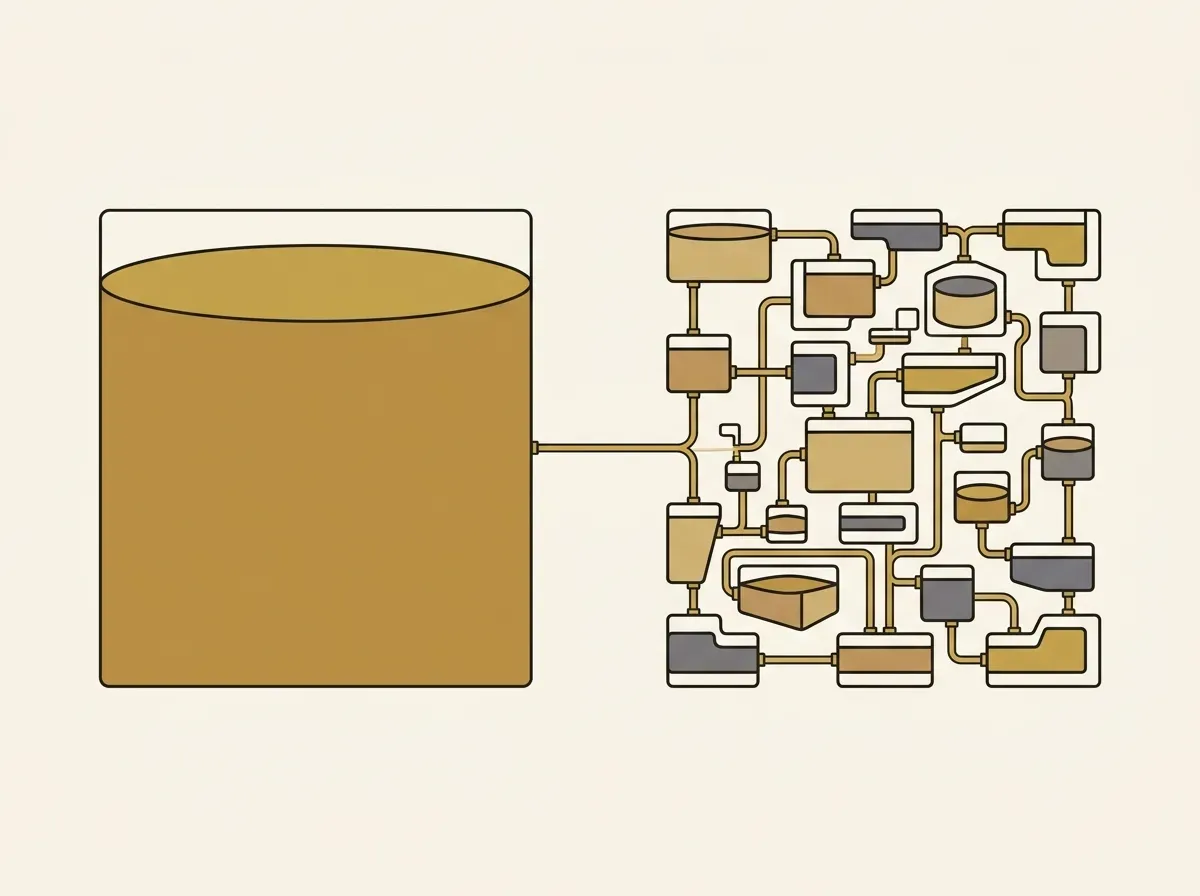
The market for tokenized stocks is a hybrid system that draws liquidity from two distinct worlds: traditional finance (TradFi) and decentralized finance (DeFi). Understanding how these sources work, and their respective limitations, is key to navigating the asset class.
Source 1: The Depth of Traditional Markets (TradFi)
The deepest and most reliable pool of liquidity for any tokenized stock is the stock's native market, such as the NASDAQ or New York Stock Exchange (NYSE). On our platform, every tokenized stock is backed 1-to-1 by a real share held in a segregated customer account at a regulated U.S. broker-dealer. You can see the real-time backing for each asset on our Proof of Reserves page. When you place a trade, our market-making partners can execute a corresponding trade on the traditional exchange. This back-to-back execution directly taps into the immense liquidity of the global equity markets, which serves as the primary source of price discovery and stability for our tokens.
Source 2: The Fragmentation of On-Chain Markets (DeFi)
Once a stock is tokenized as a standard ERC-20 asset, it can be traded in on-chain venues. This creates a secondary layer of liquidity native to the crypto ecosystem, primarily in Automated Market Maker (AMM) pools on exchanges like Uniswap or Curve. While innovative, these on-chain pools are often ill-suited for tokenized stock trades of significant size. Slippage, the difference between the expected price of a trade and the price at which it is executed, is highly sensitive to the size of the trade relative to the pool's liquidity. For example, research from Arrakis Finance on Uniswap V3 demonstrated that a liquidity pool with $500,000 in assets would produce approximately 4% slippage on a single $10,000 trade. A large, institutional-sized trade would face a dramatically more severe price impact. This illustrates why on-chain AMMs currently serve a retail-focused niche for tokenized stocks rather than providing deep, reliable liquidity for all trade sizes.
Bridging the Gap: RFQ vs. AMM Execution
Connecting these two liquidity sources efficiently presents a challenge. Relying solely on fragmented on-chain AMMs can lead to poor execution, high slippage, and exposure to Maximal Extractable Value (MEV). We solve this on GM Markets by using a Request-for-Quote (RFQ) execution model. An RFQ system works by having you request a price for a specific trade. This request is sent privately to a network of professional, regulated market makers who compete to offer the best price. They source their liquidity primarily from the deep TradFi markets, ensuring the price you receive is tightly benchmarked to the real stock. This model offers several key benefits over a standard on-chain AMM swap.
| Feature | Request-for-Quote (RFQ) Model | Automated Market Maker (AMM) Model |
|---|---|---|
| Price Source | Direct quotes from professional market makers benchmarked to deep TradFi markets (e.g., NYSE, NASDAQ). | Algorithmic price based on the ratio of assets in a finite, on-chain liquidity pool. |
| Slippage Risk | Minimal. Price is locked in before execution. Default slippage tolerance is 0.5%. | High, especially for large trades relative to pool size. Price can move significantly during execution. |
| MEV Protection | High. Trade intent is private and not broadcast to the public mempool, preventing front-running. | Low. Transactions are public in the mempool, making them vulnerable to front-running and sandwich attacks. |
| Capital Efficiency | High. Market makers use capital across the entire traditional market, not just one on-chain pool. | Low. Liquidity providers must lock capital into specific, often fragmented, on-chain pools. |
| Ideal Use Case | Executing trades of any size with price certainty and protection from MEV. | Small, retail-sized swaps or providing liquidity for assets with no off-chain market. |
The RFQ model allows our platform to tap the best available price from the entire traditional market structure. This is reflected in our simple pricing structure, which consists of a single, transparent trading fee.
The Market Maker's Dilemma: Challenges of Providing On-Chain Liquidity
Providing consistent, deep liquidity for tokenized assets is a complex task. Market makers face significant operational hurdles that are unique to the hybrid on-chain and off-chain environment. Understanding these challenges reveals why a robust execution model like RFQ is so important.
A primary issue is liquidity fragmentation. A single tokenized asset's liquidity is often split across multiple platforms and blockchains. This forces market makers to maintain a presence across all venues, which is capital-intensive. Unlike in traditional finance, they must pre-fund separate wallets for each protocol and blockchain, tying up capital inefficiently.
Another major challenge is managing risk in a 24/7 market. Tokenized assets can trade around the clock, but the underlying stock markets have set hours. When the NYSE is closed overnight or on weekends, it becomes impossible for market makers to hedge their positions on the primary market. This mismatch forces them to either widen their bid-ask spreads significantly or withdraw from the market entirely. According to a January 2026 report from CryptoRank, this dynamic causes weekend trading volumes for tokenized stocks to fall by 85% to 92% compared to weekday averages, drastically reducing liquidity.

Composability in Action: Tokenized Assets as Productive DeFi Collateral
One of the most powerful features of tokenized stocks is composability, the ability for on-chain assets to interact with each other like building blocks. When you hold a tokenized stock on our platform, you are not just holding a price-tracking instrument; you are holding a productive crypto asset. This is not theoretical. We can see this principle in action with other tokenized real-world assets across major DeFi protocols. For instance, on the decentralized lending protocol Morpho, users can supply tokenized U.S. Treasury Bill products, such as Ondo Finance's USDY, as collateral to borrow other assets. This demonstrates how a tokenized real-world asset transforms from a static investment into a productive, on-chain financial tool. The same principle applies to tokenized stocks, allowing holders to access liquidity without selling their equity exposure. Each of these use cases creates a new, organic source of on-chain liquidity. As more users deploy tokenized stocks across the DeFi ecosystem, the on-chain liquidity for these assets deepens, creating a more robust and self-sustaining market.
Frequently Asked Questions
Is liquidity for tokenized stocks available 24/7?
While tokenized stocks can be transferred on-chain 24/7, deep trading liquidity is typically aligned with the hours of the underlying traditional stock market (e.g., 9:30 AM to 4:00 PM Eastern Time for U.S. stocks). Outside these hours, market makers cannot effectively hedge their positions, which leads to wider spreads and less available liquidity, with weekend volumes often dropping by over 85%.
What is the difference between on-chain and off-chain liquidity?
Off-chain liquidity refers to trading on traditional, centralized exchanges like the NYSE or NASDAQ. This is where the vast majority of volume occurs and where the true price of a stock is discovered. On-chain liquidity refers to trading that happens directly on a blockchain, such as in an AMM pool. For tokenized stocks, the off-chain source is currently much larger and is best accessed via models like RFQ.
How do market makers provide liquidity for tokenized stocks?
Market makers are professional trading firms that provide liquidity by placing both buy (bid) and sell (ask) orders for an asset. For tokenized stocks, they typically buy and sell the token on a platform like ours while simultaneously placing an opposite trade in the underlying stock on a traditional exchange. This allows them to hedge their risk and profit from the small difference between the bid and ask prices.
Does low on-chain volume mean a tokenized stock is illiquid?
Not necessarily. For platforms like GM Markets that use an RFQ model to access deep, off-chain liquidity, the on-chain trading volume can be misleading. A token may show low volume on a DEX but still be highly liquid because trades are executed by market makers tapping into the much larger liquidity of the traditional stock market. The true measure of liquidity is the ability to execute a large trade with a tight spread and low slippage.
Trading Tokenized Stocks on GM Markets
Understanding liquidity is key to navigating the world of tokenized assets. The hybrid model, which combines the depth of traditional markets with the innovation of DeFi, offers a robust foundation for this new asset class. By using an efficient RFQ execution system, we provide direct access to this deep liquidity, ensuring reliable pricing and trade execution for our users. We believe this is the most secure and efficient way to bridge these two financial worlds.
Please note that trading digital assets involves significant risk, and you could lose your invested capital. This material does not constitute investment, financial, or legal advice. GM Markets is not offered to users in the United States or other restricted jurisdictions. For more information, please review our risk and legal disclosures.