How Tokenized Stocks Work: A Step-by-Step Guide
Learn exactly how tokenized stocks work, from the 1:1 backing by real shares to minting on-chain and real-time verification through Proof of Reserves. This step-by-step guide explains the complete, auditable lifecycle.
What is a Tokenized Stock?
A tokenized stock is a digital asset issued on a blockchain that represents economic exposure to one share of a publicly traded company. Its value is directly tied to the underlying stock because it is backed 1:1 by a real share held in a segregated account at a regulated custodian. This structure combines the price performance of traditional equity with the efficiency, global accessibility, and composability of on-chain crypto assets. The market for tokenizing real-world assets is a significant and growing sector, projected by firms like Boston Consulting Group to reach as much as $16 trillion by 2030.
This is not a theoretical concept. It is a live, auditable system for bringing global financial assets on-chain. On our platform, every tokenized stock follows a verifiable lifecycle designed for transparency and security. Here, we will explain exactly how tokenized stocks work, step by step, using the live GM Markets system as a concrete example.
Step 1: The Foundation – Purchasing and Custody of the Real Share
The entire system begins with a real, publicly traded share. Before any token can exist, a corresponding share must be purchased on a traditional exchange, such as the NASDAQ or NYSE. This purchase is the foundational source of the token's value and ensures it is grounded in a real-world asset.
Once purchased, this share is not held by us. It is delivered to a segregated customer account at a regulated, third-party broker-dealer. We use established U.S. firms for this purpose, including Interactive Brokers LLC and Alpaca Securities LLC. This step is crucial for asset security. By using independent, regulated custodians, we ensure the underlying assets are firewalled from our own operations.
The term 'segregated' is a critical legal and structural protection. It means the assets are kept entirely separate from both the broker's and our own corporate funds. This is a core investor protection mechanism mandated by regulations like the SEC's Customer Protection Rule (Rule 15c3-3). This separation ensures that the assets backing the tokens remain available to token holders even in the unlikely event of a broker's or our own insolvency.

Step 2: The Minting Process – Creating the On-Chain Token
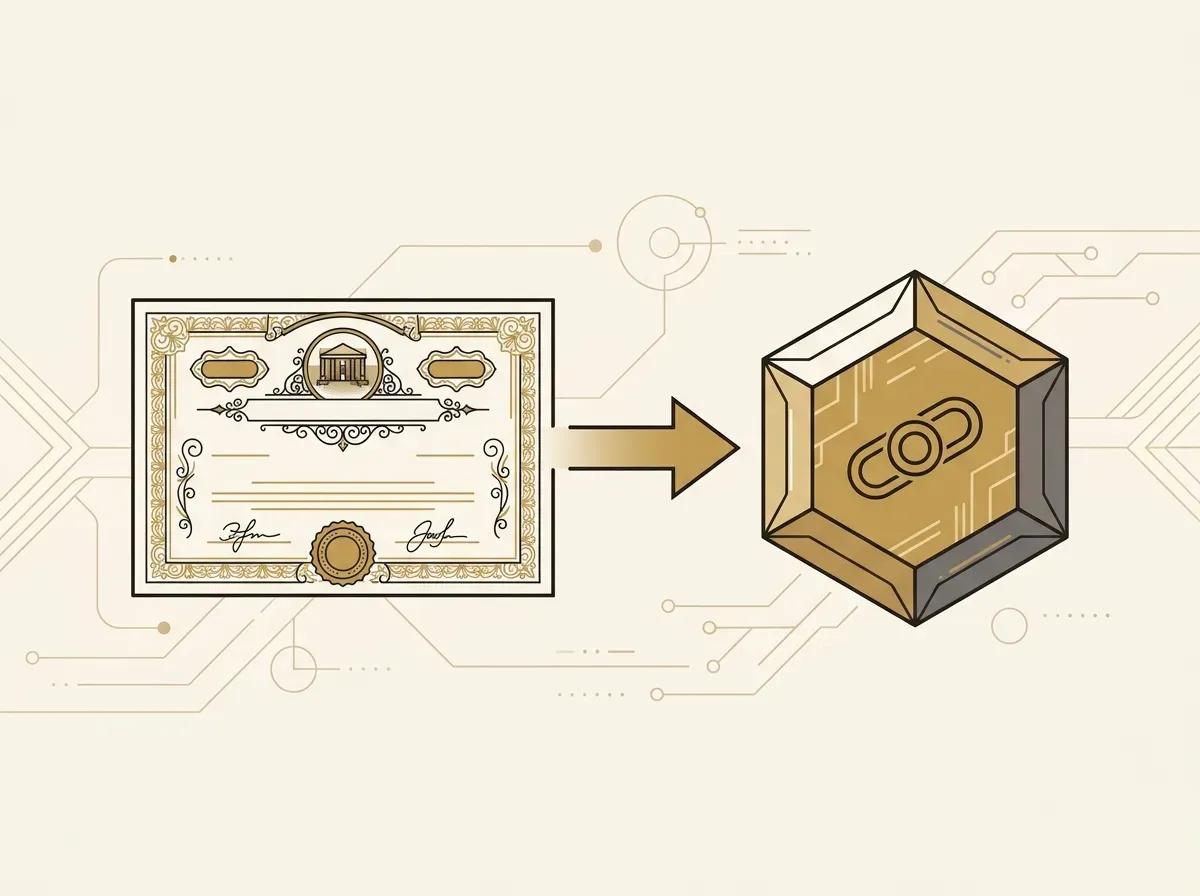
With a real share secured in custody, the on-chain representation can be created. For every one share held in the segregated brokerage account, one corresponding token is 'minted' via a smart contract. This process takes place on public, transparent blockchains. We currently support settlement on Base, Arbitrum, and Ethereum, allowing users to interact with assets on their preferred network.
The smart contract programmatically enforces a strict 1:1 backing ratio. The total supply of a given tokenized stock, for example gmTSLA, can never exceed the number of actual TSLA shares held in custody. This immutable, on-chain rule is a key source of trust and transparency in the system, replacing the need for trust in a single company's ledger.
The resulting token is a standard ERC-20 token. This technical standard is the universal language for assets on Ethereum and compatible blockchains. It ensures our tokens are immediately compatible with the vast ecosystem of decentralized finance (DeFi) applications. This interoperability, known as composability, means your tokenized stock is not a static asset. It can be used as productive collateral in lending protocols like Aave and Morpho, traded on decentralized exchanges like Uniswap, or integrated into automated portfolio management tools.
Step 3: Verification – Real-Time Proof of Reserves
A claim of 1:1 backing is only meaningful if it can be independently and continuously verified. We achieve this through a transparent Proof of Reserves system. This system relies on a third-party attestation service, Accountable, which has secure, read-only API access to our brokerage accounts.
Accountable continuously monitors the number of shares held in custody for each asset and publishes this data directly on-chain. This allows anyone, at any time, to perform a simple, public audit without needing our permission:
- Check the total circulating supply of a specific tokenized stock (e.g., gmNVDA) on a public block explorer like Etherscan or Basescan.
- Compare that number to the attested number of real NVDA shares held in custody, as reported by the on-chain attestation contract.
The two numbers should always match. This real-time, on-chain transparency provides a much higher degree of assurance than the periodic, paper-based audits common in traditional finance. It is a verifiable fact, not a trusted promise.

Step 4: Trading and Settlement – The User Experience
For a user, the process of acquiring a tokenized stock is designed for security and simplicity. You can connect an existing external wallet or create a new embedded wallet directly in your browser. These embedded wallets are operated by Privy and secured with Multi-Party Computation (MPC) technology. MPC splits your private key into multiple shares, meaning no single party, including GM Markets or Privy, ever has access to the full key. This provides the security of self-custody without the traditional complexity of managing seed phrases.
When you place a trade, our platform uses a Request-For-Quote (RFQ) system. We source a real-time price from regulated market makers who are pricing the asset against the live underlying market. You see a final, all-inclusive price. The trading fee, which is our only revenue source, ranges from 10 to 20 basis points (0.10% to 0.20%) and is included in this quote. There are no deposit, withdrawal, or custody fees. You can find a full breakdown on our pricing page.
Upon acceptance, the trade settles nearly instantly on the blockchain. The token is transferred to your wallet, and the stablecoins are transferred from your balance. This settlement speed is a significant advantage. While traditional U.S. stock markets recently moved to a T+1 settlement cycle (one business day), on-chain transactions achieve finality in minutes. This dramatically reduces counterparty risk and improves capital efficiency.
Step 5: Corporate Actions and Dividends – The Total Return Model
A tokenized stock must accurately reflect all economic events of its underlying counterpart, including corporate actions like dividends and stock splits. On our platform, we use a 'total return' model to handle these events automatically and efficiently on-chain.
When a company like Apple pays a dividend, those funds are not paid out to token holders as cash. Distributing small cash payments to thousands of individual wallets across multiple blockchains would be inefficient. Instead, the dividend proceeds are automatically used by the custodian to purchase more of the underlying AAPL shares. This increases the total number of shares held in the custody account, which in turn increases the Net Asset Value (NAV) backing each token. You see the value of the dividend reflected directly in the token's price appreciation.
Similarly, other corporate actions like stock splits or mergers are automatically absorbed into the token's on-chain NAV. This model ensures that your tokenized position always tracks the precise economic exposure of the underlying stock without requiring any manual intervention on your part.
Step 6: Redemption and Continuity – The Exit Path
A financial instrument is only useful if it has a clear and reliable exit path. You can sell your tokenized stocks on GM Markets at any time during market hours for stablecoins, which can then be withdrawn from the platform.
The system is also designed for long-term continuity. A legal framework is in place to protect token holders if GM Markets were to cease operations. A designated, independent security agent has the authority to work directly with the custodian to redeem all outstanding tokens for the underlying shares or their cash equivalent on behalf of token holders. This structural protection, detailed on our security page, ensures the value of your tokens is tied to the underlying assets, not the operational status of our platform.
Frequently Asked Questions
What is the main difference between a tokenized stock and a traditional stock?
The primary difference is the nature of ownership. A traditional stock represents direct legal ownership in a company, which includes rights like voting on corporate matters. Our tokenized stocks provide direct economic exposure to the asset's price performance and dividends via the total return model, but they do not confer shareholder voting rights. The token represents a claim on the underlying share held in custody.
Are tokenized stocks safe?
Tokenized stocks involve specific risks, including smart contract vulnerabilities, platform risk, and counterparty risk with the custodian. We mitigate these risks through several layers: our smart contracts are independently audited, the underlying assets are held by regulated third-party brokers in segregated accounts, and our 1:1 backing is verifiable on-chain in real time via our Proof of Reserves system. However, all trading involves risk, and you should understand these before transacting.
How do dividends work with tokenized stocks?
We use a total return model. When a company pays a dividend, the funds are used to buy more of the underlying stock. This increases the value backing each token, causing the token's price to rise by the dividend amount. You receive the economic benefit of the dividend through price appreciation rather than a separate cash payment.
What are the fees for trading on GM Markets?
Our only fee is a trading fee of 0.10% to 0.20% (10 to 20 basis points), which is included in the price you are quoted. The exact rate depends on your trading volume. We do not charge any fees for deposits, withdrawals, custody, or account inactivity.
Conclusion: The Complete, Verifiable Lifecycle
Tokenized stocks bridge the gap between traditional finance and the on-chain economy through a transparent and auditable process. The lifecycle is a closed loop built on verification: a real share is purchased and held in a segregated account, a token is minted on-chain with a 1:1 backing ratio, this backing is continuously verified by a third party, and the token can be traded with near-instant settlement. This structure provides direct economic exposure to real-world assets while unlocking the powerful composability of DeFi. To learn more, you can explore our guide to tokenized stocks or view our live Proof of Reserves.
Please note that all trading involves risk, including the potential loss of principal. Our services are not offered to users in the United States or other restricted jurisdictions. For more information, please review our legal disclosures.