How to Buy US Stocks with USDC On-Chain
Learn how to buy US stocks with USDC on-chain, bypassing the high fees and long delays of traditional cross-border brokerage. A step-by-step guide.
The Challenge of Traditional Cross-Border Investing
For investors outside the United States, buying US-listed stocks like NVIDIA or Tesla has historically been a process defined by high costs, long delays, and operational friction. Converting local currency or stablecoins into equity exposure through legacy channels involves a chain of intermediaries, each adding complexity and extracting value. This friction creates a significant barrier between the global digital asset economy and the world's largest equity markets.
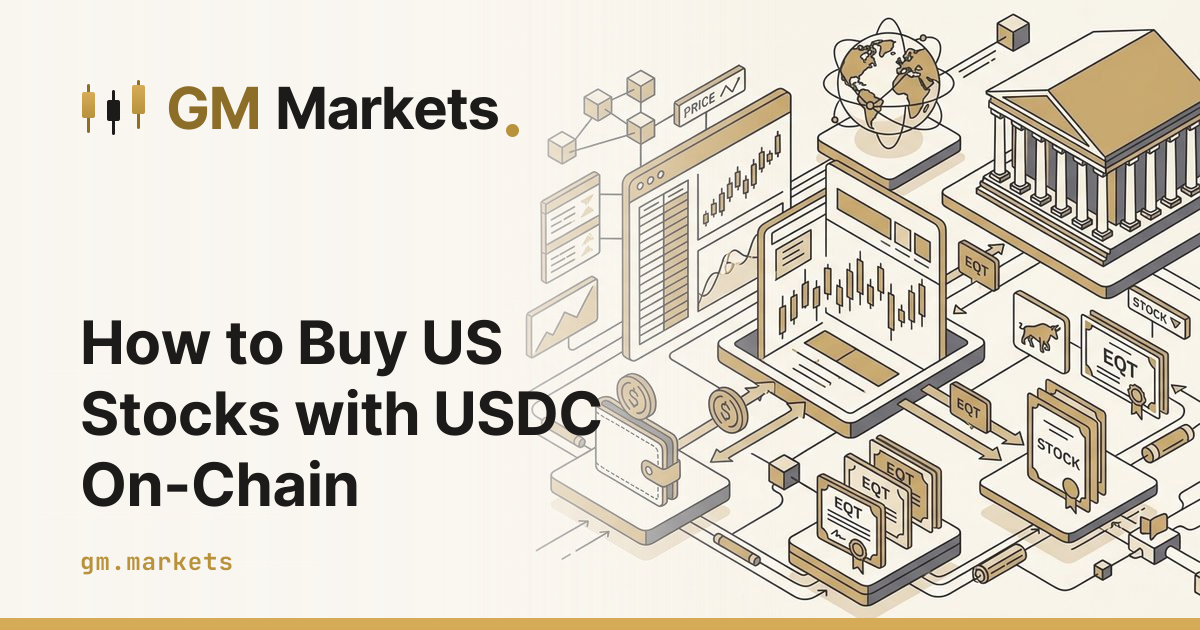
We built GM Markets to dismantle these barriers. Our platform offers a direct, on-chain path to convert stablecoins like USDC into fully-backed tokenized US stocks. This guide explains the specific challenges of the traditional system and provides a step-by-step walkthrough of how you can use our platform to gain exposure in minutes, not weeks.

Financial Barriers in Legacy Brokerage
The costs of traditional cross-border investing go far beyond simple trading commissions. Investors often face a stack of fees that can significantly erode returns:
- High Minimum Deposits: Many US brokers require substantial initial funding for international accounts. Charles Schwab International, for example, has a minimum deposit of $25,000, placing it out of reach for many retail investors.
- Wire Transfer Fees: Funding an international account typically requires a wire transfer, which can cost between $35 and $50 per transaction for both deposits and withdrawals.
- Currency Conversion (FX) Markups: This is one of the most significant and least transparent costs. When you convert your local currency to US dollars, banks and brokers apply a markup to the exchange rate that can range from 0.5% to over 3%. On a $5,000 transaction, a 3% markup results in an immediate $150 cost. The Financial Stability Board (FSB), in a G20 initiative, has consistently identified high costs as a primary challenge in cross-border payments.
Logistical Hurdles and Settlement Risk
Beyond the direct costs, the process itself is slow and complex:
- Lengthy Account Opening: Opening a US brokerage account as a non-resident is not instant. It can take several days to multiple weeks, involving extensive paperwork like the IRS Form W-8BEN to certify foreign status for tax purposes.
- T+1 Settlement Challenges: In May 2024, the US market moved to a T+1 settlement cycle, meaning trades must be settled one business day after execution. For international investors, this compresses the time available for post-trade processing by as much as 83%. This creates a high risk of settlement failures, as there is a much smaller window to complete the necessary foreign exchange transactions. It may even force investors to pre-fund trades, tying up capital inefficiently.
A Modern Solution: Buying Tokenized Stocks on GM Markets
Our platform uses blockchain technology to bypass the inefficiencies of the traditional system. The entire process, from connecting a wallet to holding a tokenized stock, is designed for speed and self-custody. Here is the direct path to your first trade.
Step 1: Connect or Create Your Wallet
First, visit the GM Markets trading application. You can connect an existing Web3 wallet like MetaMask or create a new, embedded wallet using a Google account or an email address. This embedded wallet is secured by Privy’s multi-party computation (MPC) technology, providing self-custody without the user needing to manage a seed phrase.
Step 2: Deposit USDC
Once your wallet is connected, navigate to the deposit section. You can deposit USDC directly from multiple supported blockchains, including Base, Arbitrum, Ethereum, and Optimism. The platform automatically converts your deposits into a unified USDF balance, which is backed 1:1 by USDC and USDT, simplifying cross-chain transactions. We charge no fees for deposits.
Step 3: Choose Your Asset
With funds in your account, go to the markets page to find a list of available tokenized US stocks and ETFs. Every asset listed is a tokenized representation of a real share, fully backed and verifiable on-chain.
Step 4: Execute Your Trade
Select the asset you want to buy and enter the USDF amount you wish to spend. Our platform uses a Request-For-Quote (RFQ) system, which provides a firm price from our market-making partners. The price in the 'You will receive' field is final and includes our transparent trading fee. This protects you from the price slippage common on other on-chain venues. Confirm the quote to execute the trade.
Step 5: Confirm and View Your Assets
After you confirm, the transaction settles on-chain almost instantly. The tokenized stock appears in your on-platform portfolio and is held in the wallet you control. You can view the asset on a block explorer and are free to hold, sell, or use it across the DeFi ecosystem.
How the On-Chain Infrastructure Works
Several core technologies make this seamless experience possible, bridging the gap between traditional finance and decentralized infrastructure.
1:1 Backing and On-Chain Proof of Reserves
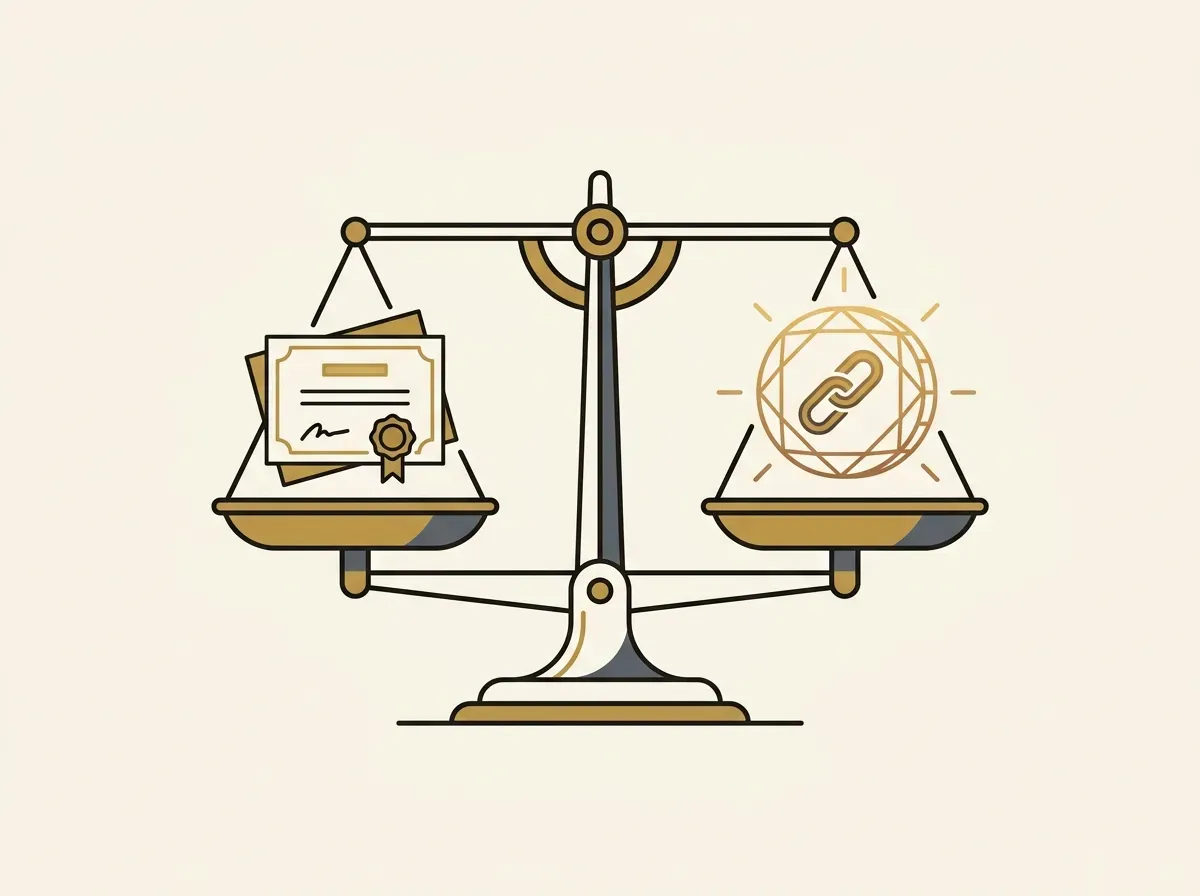
Every tokenized stock we issue is backed 1:1 by a corresponding real share held in a segregated customer account at a regulated US broker-dealer, such as Interactive Brokers. This is not a synthetic or derivative product. We provide full transparency through our Proof of Reserves page, where reserves are verified on-chain in real time by the third-party attestation provider, Accountable.
RFQ Execution: Price Certainty vs. AMM Slippage
Unlike decentralized exchanges that use Automated Market Makers (AMMs), our RFQ model provides price certainty. In an AMM, large trades can cause slippage, where the final price is worse than the expected price. With RFQ, you receive a guaranteed quote that is held for a short window. This ensures you know the exact cost and quantity before you commit, which is critical for trading volatile assets.
MPC Wallets: Self-Custody Without Seed Phrases
Our integration with Privy for embedded wallets lowers the barrier to entry for users new to self-custody. MPC technology provides robust security by splitting the private key into multiple shares, eliminating a single point of failure. This delivers the security of self-custody without the traditional complexities of seed phrase management.
Total-Return Model: How Dividends Work
Our tokens operate on a total-return basis. When a company like Apple pays a dividend, the proceeds are automatically used to purchase more of the underlying stock. This increases the net asset value (NAV) of the token, which is reflected directly in its price. You receive the full economic benefit of the dividend without it being a separate taxable event in many jurisdictions.
Beyond Holding: DeFi Composability of Tokenized Stocks
Owning a tokenized stock on GM Markets gives you more than just price exposure. Because these are standard ERC-20 tokens, they are composable within the broader DeFi ecosystem. This transforms a static equity position into a productive, on-chain asset. The market for tokenized real-world assets is projected by firms like Boston Consulting Group to grow into a multi-trillion dollar industry, and composable equity tokens are a key part of this evolution.

Collateral for Lending and Borrowing
The primary use case is unlocking liquidity. You can deposit your tokenized stocks as collateral in lending protocols like Aave and Morpho to borrow stablecoins. This allows you to retain your equity exposure while gaining access to capital for other investments without selling your position.
Providing Liquidity on Decentralized Exchanges
Tokenized stocks can be paired with stablecoins (e.g., tokenized TSLA and USDC) and deposited into liquidity pools on decentralized exchanges. By providing liquidity, you can earn trading fees from users swapping between the two assets, generating a yield on your holdings.
Frequently Asked Questions
What are the fees for buying tokenized stocks with USDC?
The only fee is a trading fee that ranges from 0.10% to 0.20%, depending on your trading volume. This fee is included in the price you are quoted. There are no fees for deposits or withdrawals. You can find full details on our pricing page.
Do I own the underlying stock?
You own a token that represents a 1:1 claim on the underlying share held in custody. The token provides you with the full economic exposure, including price movements and dividends. It does not, however, confer shareholder voting rights.
Is this service available to users in the United States?
No. GM Markets is not offered to persons or entities in the United States or other restricted jurisdictions. Our services are designed for a global, non-U.S. audience.
How can I verify the reserves backing my tokens?
You can view our real-time, on-chain Proof of Reserves dashboard at any time. It shows the total supply of each tokenized asset and the corresponding shares held at our custodian brokers, as attested by a third-party verifier.
The Direct Path from Crypto to Global Equities
GM Markets provides the most direct way for global investors to use stablecoins like USDC to access the US equity market from their own wallet. By replacing legacy infrastructure with transparent, on-chain rails, we allow you to move from crypto to stocks in minutes.
All trading involves risk. The value of tokenized stocks can go down as well as up, and you may lose the money you invest. The platform carries smart contract, settlement, and counterparty risks. Please review our legal and risk disclosures before trading. This service is not available to users in the United States or other restricted jurisdictions.