How to Bridge Crypto to Buy Tokenized Stocks: A Step-by-Step Guide
Learn how to securely bridge crypto assets like USDC from any blockchain to access tokenized U.S. stocks. This guide covers bridge mechanics, risks, and a step-by-step process.
How to Bridge Crypto to Buy Tokenized Stocks: A Step-by-Step Guide
The world of digital assets is a multi-chain ecosystem. Your capital may exist as stablecoins on Polygon, Solana, or BNB Chain, while opportunities to invest in new asset classes, like tokenized U.S. stocks, are often concentrated on high-performance networks like Base, Arbitrum, and Optimism. To connect these separate environments and put your capital to work, you need a secure method to move it from one blockchain to another. This process is called bridging.
This guide provides a detailed, practical overview of how to bridge your crypto assets to trade on GM Markets. We explain the core concepts behind cross-chain bridges, walk through the steps of a transfer, and detail how our platform simplifies the final deposit process. By bridging your funds, you can access 1:1 backed tokenized stocks and ETFs from nearly any corner of the on-chain world. Please note that our services are not offered to users in the United States or other restricted jurisdictions.
Understanding Cross-Chain Bridges: The Core Concepts
A blockchain bridge is a protocol that facilitates the transfer of assets or data between two independent blockchain networks. Since blockchains cannot natively communicate with one another, bridges act as neutral validators, confirming an action on a source chain to trigger a corresponding action on a destination chain. The process involves a bridge protocol locking or burning tokens on the source chain and then minting an equivalent amount on the destination chain.
There are several models for how bridges operate, each with different security and efficiency trade-offs:
- Lock-and-Mint: This is a common model where the bridge locks the original asset in a smart contract on the source chain and mints a new, wrapped version of that asset on the destination chain. The wrapped asset is a claim on the locked original.
- Burn-and-Mint: For assets that exist natively on multiple chains, like USDC, protocols can burn the asset on the source chain and authorize the minting of the native asset on the destination chain. Circle's Cross-Chain Transfer Protocol (CCTP) is an example of this model. It avoids the risks associated with large, locked liquidity pools by destroying tokens on the origin and creating new, native ones at the destination, verified by Circle's attestation service.
- Liquidity Pools: Some bridges maintain pools of the same asset on multiple chains. When you deposit an asset on the source chain, the bridge releases the equivalent amount from its liquidity pool on the destination chain, often offering faster settlement.
Using a bridge is essential for accessing platforms like ours, as we operate on specific Layer 2 networks to provide a low-cost, high-speed trading experience. Bridging allows you to move your capital to these efficient environments to purchase tokenized securities that offer economic exposure to real-world assets.
A Step-by-Step Guide to Bridging Assets for Trading
Moving your assets across chains requires careful execution. While we do not operate or endorse any specific third-party bridge, the general process involves the following steps. We recommend using established protocols with a strong history of security and public audits.
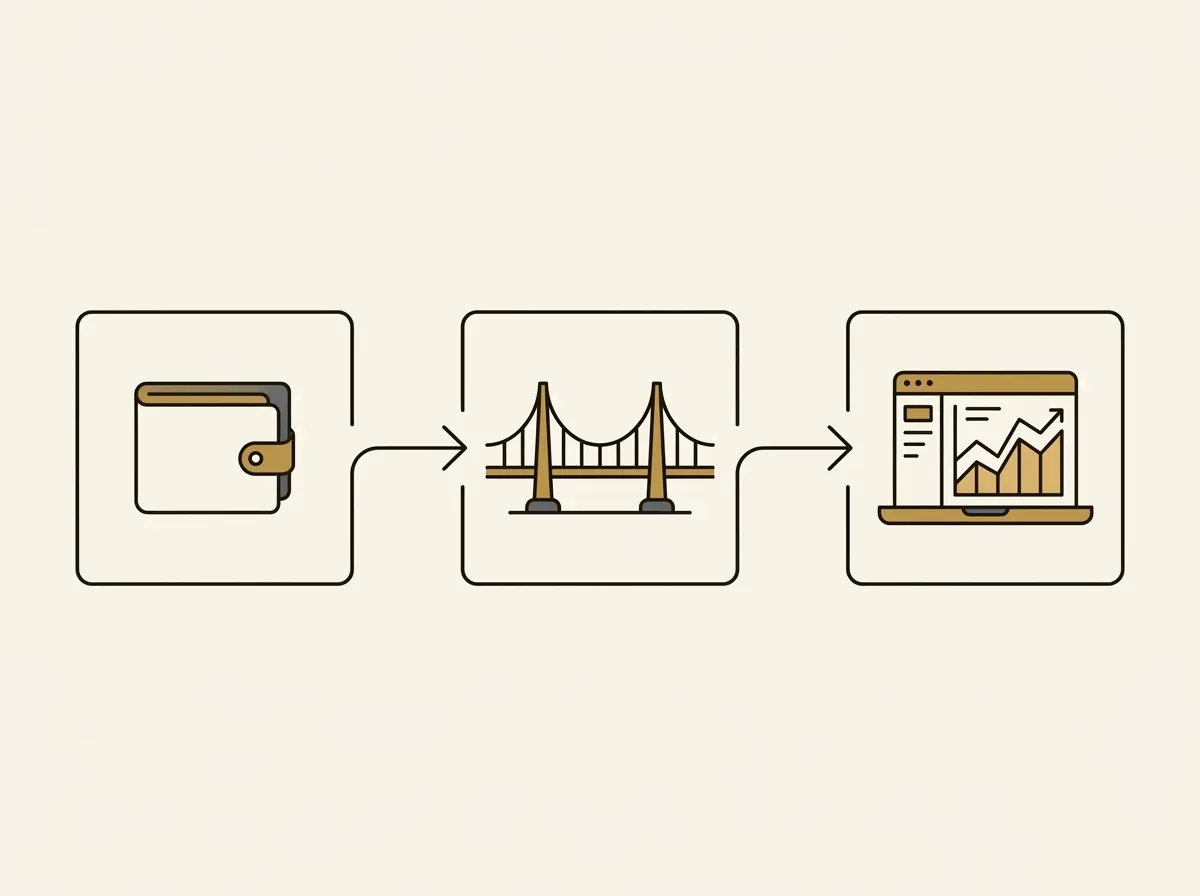
Step 1: Define Your Route and Asset
First, identify your source chain (where your funds currently reside) and the destination chain you wish to bridge to. GM Markets supports deposits from Base, Arbitrum, Optimism, and Ethereum. Base is often an excellent choice due to its very low transaction fees. Next, select the asset you will transfer. For trading, this is typically a stablecoin like USDC or USDT.
Step 2: Research and Select a Bridge Protocol
The security of cross-chain bridges is not uniform. These protocols are frequent targets for exploits, so your choice of bridge is the most critical decision in this process. Use data from trusted sources like DeFiLlama to see which bridges have the most total value locked (TVL) and a long operational history. Resources like L2BEAT offer detailed risk frameworks for evaluating the security assumptions of different bridges. Look for protocols that have undergone multiple, recent security audits from reputable firms.
Different bridges use different technical architectures. For instance, a protocol like Stargate uses unified liquidity pools built on the LayerZero messaging protocol. This allows it to deliver native assets on the destination chain, avoiding the complexity of wrapped tokens. Its Delta algorithm automatically rebalances liquidity to keep popular routes active. In contrast, an intent-based protocol such as Across uses a network of independent relayers who compete to front funds to the user on the destination chain almost instantly. The relayer is then reimbursed from a central liquidity pool. This model is designed for speed and is often cost-effective for smaller transfers.
Step 3: Connect and Configure the Transfer
Once you have chosen a bridge, navigate to its official website, and double-check the URL to avoid phishing scams. Connect your self-custodial wallet (such as MetaMask, Coinbase Wallet, or Rainbow). In the bridge's user interface, carefully select the source and destination chains and the asset you are transferring. Enter the amount you wish to bridge. The interface should provide an estimate of the fees and the amount you will receive. For a first-time transfer on a new bridge, it is a sound practice to send a small test amount first.
Step 4: Approve and Execute the Bridge Transaction
Before the bridge can move your funds, you must grant its smart contract permission to access the tokens in your wallet. This is a standard ERC-20 approve transaction. After the approval is confirmed on-chain, you can proceed to execute the main bridging transaction. This will initiate the cross-chain transfer and will require you to pay a gas fee on the source chain. The total cost includes this gas fee plus any fee charged by the bridge protocol itself.
Step 5: Verify Funds on the Destination Chain
Cross-chain transactions are not always instant. Depending on the bridge architecture and network congestion, the process can take anywhere from a few minutes to over an hour. Most bridges provide a link to a block explorer where you can track the status of your transaction. Once complete, you can add the destination network to your wallet and confirm the arrival of your funds.
Depositing on GM Markets: The Final, Seamless Step
After your USDC or USDT has arrived on a supported chain like Base or Arbitrum, the most difficult part is over. We have designed our platform to make the final deposit step simple and efficient. When you connect your wallet to GM Markets, you can use one of our embedded wallets operated by Privy, which use multi-party computation (MPC) for enhanced security.
Navigate to the deposit page, select the stablecoin you bridged, and enter the amount. Our system automatically detects your deposit and credits your account with USDF, our unified stablecoin balance. This means your USDC or USDT from any supported chain is converted into a single, fungible balance for trading. USDF works seamlessly across all our supported chains, so you never need to bridge again between Base and Arbitrum to manage your portfolio with us.
Furthermore, our platform abstracts gas fees. You do not need to hold a native token like ETH on Base to make a deposit or a trade. The network fees are paid by our smart account and deducted from your USDF balance, simplifying the user experience.
Key Risks and Security Considerations When Bridging
While powerful, cross-chain bridges introduce unique risks. You are responsible for the security of your assets during the bridging process. According to a report from the blockchain analysis firm Chainalysis, an estimated $2 billion was stolen in 13 separate cross-chain bridge hacks in 2022 alone, accounting for 69% of all stolen crypto funds that year. This highlights why careful protocol selection is essential.
Major historical exploits demonstrate the potential dangers:
- Smart Contract and Protocol Risk: A bug in a bridge's smart contract code can lead to a complete loss of user funds. The 2022 Wormhole hack, which resulted in a loss of over $320 million, was caused by a vulnerability that allowed an attacker to mint unbacked wrapped ETH on a destination chain.
- Validator or Relayer Security Risk: Many bridges rely on a set of validators or relayers to verify transactions between chains. If these entities are compromised, they can approve fraudulent transactions. This was the cause of the Ronin bridge hack, where attackers gained control of a majority of validator keys and drained over $600 million.
- Custody Risk: During a transfer, your assets may be held in custody by the bridge protocol. It is critical to understand who controls the smart contracts and what protections are in place.
Always research a bridge's security model before use. While bridging involves external risks, once your assets are on our platform, they are secured by our audited smart contracts and our 1:1 backing model, which you can verify on our Proof of Reserves page. For a full overview of platform-specific risks, please review our risk disclosures.
Frequently Asked Questions
What is the difference between using a bridge and a centralized exchange (CEX) to move funds?
A bridge allows you to move assets between blockchains while maintaining self-custody of your funds in your own wallet. A CEX requires you to first deposit your assets into their custodial wallet, make a withdrawal to the new chain, and then connect to a platform. Bridging is a more direct, on-chain method.
Do I need ETH on Base to deposit USDC on GM Markets?
No. Our platform uses smart accounts that abstract gas fees. When you make a deposit or trade, the required network fee is paid on your behalf and the equivalent value is deducted from your USDF stablecoin balance. You do not need to acquire or hold the native gas token of the chain you are using.
How long does a typical bridging transaction take?
Transaction times vary based on the bridge protocol and the level of network congestion on both the source and destination chains. Most transfers on modern bridges to Layer 2 networks like Base or Arbitrum complete in 2 to 15 minutes. Some older bridges or transfers to Ethereum mainnet can take longer.
Can I bridge any crypto asset to buy stocks?
While you can bridge many different assets, you must deposit a supported stablecoin, like USDC or USDT, to begin trading on GM Markets. We convert these deposits into a unified USDF balance that is used for all trades and is reflected in our fee structure.
Conclusion: Your Gateway to On-Chain Equities
Bridging is a fundamental process for moving capital efficiently across the multi-chain landscape. By selecting a secure protocol and following a methodical process, you can transfer assets from any ecosystem to a platform like GM Markets. This unlocks the ability to gain economic exposure to U.S. stocks and ETFs, turning your existing on-chain capital into a tool for accessing global equity markets.
Once your funds are on a compatible network, you are ready to begin. Visit the GM Markets deposit page to complete the final step and explore available assets like SPY and QQQ.