How Do Tokenized Stocks Work? A Complete Guide to Mechanics, Risks, and Costs
Learn how tokenized stocks work, from the 1:1 backed minting process to multi-chain trading. This complete guide covers the lifecycle, costs, risks, and security.
How Do Tokenized Stocks Work? A Complete Guide to Mechanics, Risks, and Costs
Tokenized stocks are a core component of the on-chain economy, offering a way to access global equity markets with the efficiency and flexibility of crypto assets. But how does a share of a company like NVIDIA actually become a token you can hold in a digital wallet? The process involves a clear, auditable lifecycle designed to ensure every on-chain token is verifiably backed by a real-world share.
As a platform that issues and facilitates trading of these instruments, we believe in full transparency. This guide explains the precise mechanics behind tokenized stocks, from the moment you place a trade to how the underlying asset is purchased, custodied, and represented on the blockchain. We will also cover the multi-chain environments they operate in, the costs involved, the specific risks to consider, and the continuity plans that protect assets. Understanding this complete picture is key to recognizing the security and utility of these instruments.
What Is a Tokenized Stock, Exactly?
A tokenized stock is a digital token on a blockchain that represents a direct, 1:1 claim on one share of a traditional stock. For every tokenized NVDA that exists on-chain, one full share of NVDA is held in custody at a regulated financial institution. This principle of 1:1 backing is the fundamental difference between a tokenized stock and other instruments like Contracts for Difference (CFDs) or synthetic assets, which only mimic price movements without conferring a claim on the underlying share.
Financial regulators operate on a principle of “substance-over-form.” As the U.S. Securities and Exchange Commission (SEC) clarified in a joint public statement, the economic reality of an instrument, not its technological label, determines its classification. If an asset functions like a security, it is regulated as a security. Tokenized stocks fall squarely into this category. They are traditional securities presented in a new, more efficient format, not a new type of asset altogether.

The Lifecycle of a Tokenized Stock: A Step-by-Step Guide
To understand how tokenized stocks work, it is helpful to follow the lifecycle of a single trade. The entire process is designed to ensure that the 1:1 backing is maintained and verifiable at every stage.
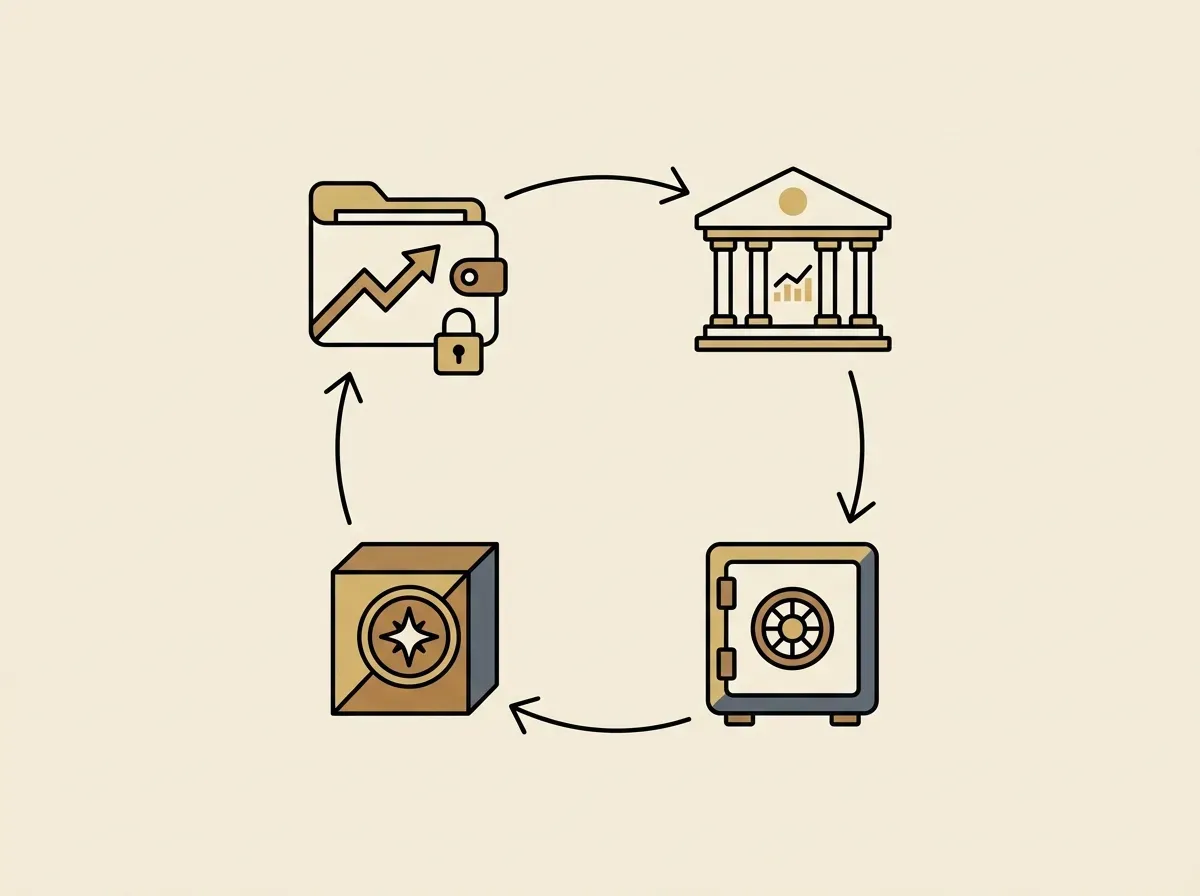
Step 1: You Deposit Funds and Place an Order
The process begins when you fund your account, typically using stablecoins like USDC or USDT. On our platform, these are unified into a single USDF balance for simplicity. You then place a buy order for a specific asset, for example, 0.5 shares of Tesla. Our platform connects to a network of regulated market-making partners to source a real-time price for your consideration before you commit to the trade.
Step 2: A Real Share Is Purchased via RFQ Execution
Once you accept the quote, our system executes the order using a Request-For-Quote (RFQ) model. This means that instead of sending a simple market order to a public exchange, we request competitive quotes from multiple institutional market makers. These partners purchase the exact amount of the underlying stock, in this case, 0.5 shares of TSLA, directly from a traditional exchange like the NASDAQ. The RFQ model provides several benefits, including deeper liquidity and protection against price slippage, as the price is locked in before you confirm the trade.
Step 3: The Share Is Placed in Segregated Custody
The purchased share is then delivered to a segregated customer account held at one of our regulated broker-dealer partners, such as Interactive Brokers or Alpaca Markets. “Segregated” is a critical term. It means your assets are kept completely separate from the assets of GM Markets and the broker itself. This structure protects your assets in the event of a firm’s failure.
Because the shares are held at U.S. broker-dealers who are members of the Securities Investor Protection Corporation (SIPC), the assets in these accounts are protected. As explained on the official SIPC website, this protection covers the custody of securities and cash up to $500,000 per customer if a brokerage firm fails and assets are missing. This protection applies to all customers of a SIPC-member firm, regardless of their citizenship or country of residence. It is important to note that SIPC does not protect against market losses from price fluctuations.
Step 4: The On-Chain Token Is Minted to Your Wallet
With the real share secured in custody, our audited smart contract receives a cryptographic confirmation. The contract then mints the corresponding token, in this case, 0.5 gTSLA, and delivers it directly to your self-custodial wallet. On our platform, we use embedded wallets from Privy, which use Multi-Party Computation (MPC). MPC technology splits the private key into multiple shares, which are stored in different places. This eliminates a single point of failure, as a complete key never exists in one location, providing enhanced security without the user needing to manage a complex seed phrase.
Step 5: Backing Is Verified with Proof of Reserves
This is where transparency becomes paramount. To prove that every token is backed, we use a real-time, on-chain attestation service from Accountable. This service uses advanced cryptography to continuously and independently verify the number of shares held in our segregated brokerage accounts and publishes this data on the blockchain. You can visit our Proof of Reserves page at any time to see the total supply of each token and the corresponding amount of shares held in custody, verifying the 1:1 backing for yourself.
Step 6: Selling Your Token Reverses the Process
When you decide to sell your tokenized stock, the entire process works in reverse. You place a sell order, and upon execution, the on-chain token is “burned,” or permanently removed from circulation. Simultaneously, the underlying share is sold on the open market, and the cash proceeds are credited to your account balance. This mint-and-burn mechanism ensures that the total supply of tokens on-chain never exceeds the number of shares held in custody.
Multi-Chain Access and Transparent Costs
A key advantage of tokenized assets is the ability to operate across multiple blockchain ecosystems while maintaining a simple and transparent cost structure. This design provides both flexibility and clarity for users.
Trade Across Leading Blockchains
Our platform operates on a multi-chain infrastructure, with tokens available on Base, Arbitrum, Ethereum, and Optimism. This allows you to choose the network that best suits your needs for speed, cost, or integration with other DeFi applications. You can deposit, withdraw, and trade on any of these supported chains directly from your unified account.
Simplified On-Chain Experience with Gas Abstraction
A significant point of friction in DeFi is the need to acquire and manage the native token of each blockchain (like ETH) to pay for transaction fees, known as gas. We eliminate this complexity through gas abstraction. Our smart accounts automatically pay the required network gas fees and then bill the equivalent cost in USDC from your balance. This means you never need to hold a native chain token, streamlining the trading experience across all supported networks.
A Clear and Simple Fee Structure
Our revenue model is based on a single, transparent trading fee. We do not charge fees for deposits, withdrawals, custody, or account inactivity. The trading fee ranges from 10 to 20 basis points (0.10% to 0.20%) and is included in the price you are quoted. This means the amount you see is the amount you get, with no hidden charges. The fee you pay is determined by your 14-day trading volume via our VIP program, which rewards active traders with lower costs. You can review the full structure on our pricing page.
| Tier | Trading Fee | 14-Day Volume |
|---|---|---|
| VIP 1 | 0.20% | < $1,000 |
| VIP 2 | 0.175% | $1k – $10k |
| VIP 3 | 0.15% | $10k – $100k |
| VIP 4 | 0.125% | $100k – $1M |
| VIP 5 | 0.10% | ≥ $1M |
Unlocking On-Chain Composability
One of the most powerful features of tokenized stocks is their ability to integrate with the broader Decentralized Finance (DeFi) ecosystem. Unlike a share held in a traditional brokerage account, a tokenized stock is a programmable, ERC-20 compliant asset that can be used as productive capital.
This composability unlocks several use cases:
- Lending and Borrowing: You can supply your tokenized stocks as collateral on lending platforms like Aave or Morpho to borrow other assets, such as stablecoins. This allows you to access liquidity without selling your equity positions.
- Liquidity Provision: You can pair your tokenized stocks with other assets (like USDC) and deposit them into liquidity pools on Automated Market Makers (AMMs) like Uniswap or Curve. In return, you earn trading fees from users who swap between the assets in the pool.
- Margin and Leverage: On decentralized derivatives and perpetuals protocols, you can use tokenized stocks as margin to trade with leverage, enabling more complex trading strategies.
These capabilities transform a passive holding into an active financial instrument, creating opportunities that are not available in the traditional financial system. You can explore more about these concepts on our tokenized stocks learning page.

Understanding the Unique Risks of Tokenized Stocks
While tokenized stocks offer novel benefits, they also introduce a unique set of risks beyond the market risk inherent in any equity investment. Understanding these risks, which stem from the underlying technology and operational structure, is essential.
Smart Contract Risk
The tokens and their governing logic are encoded in smart contracts. While these contracts are audited, they can still contain vulnerabilities. A bug or flaw in the code could be exploited by malicious actors, potentially leading to a loss of assets. The complexity of financial logic on-chain means that even rigorously audited contracts are not entirely immune to undiscovered exploits.
Counterparty Risk
Counterparty risk is the risk that another party in a transaction will fail to fulfill its obligation. In our system, this risk exists with the regulated brokers that custody the underlying shares and the market makers who provide liquidity for trades. While we partner with established, regulated institutions, their financial failure, though unlikely, could impact the assets they hold. The use of segregated accounts is a primary mitigation for this risk, designed to protect client assets from a firm's insolvency.
Custody Risk
Custody risk involves the safekeeping of the digital assets and the private keys that control them. While our embedded MPC wallets are designed to eliminate single points of failure, risk still exists. The irreversible nature of blockchain transactions means a compromised key or a failure in the wallet infrastructure could lead to a permanent loss of assets. Users of external, self-custody wallets bear the full responsibility for securing their own private keys.
The Continuity Plan: What Happens if a Platform Fails?
A critical component of our trust and security model is a robust continuity plan. To protect user assets, the tokens are issued by a bankruptcy-remote Special Purpose Vehicle (SPV). This is a distinct legal entity that holds the underlying shares, isolating them from the operational and financial health of GM Markets. In a wind-down scenario, creditors of GM Markets would have no claim on the assets held in the SPV.
If GM Markets were to cease operations, a designated security agent, or trustee, is contractually empowered to take control of the assets in the SPV. This independent agent's fiduciary duty is to act in the best interests of the token holders. The process would involve securing the brokerage accounts, overseeing the orderly liquidation of the underlying shares, and distributing the proceeds to token holders in proportion to their holdings. This legal structure ensures a clear path for asset recovery that is independent of the platform's operational status.
Key Differences from Traditional Stock Ownership
While tokenized stocks provide the same economic exposure as traditional shares, their on-chain nature introduces several key differences. We have summarized the most important distinctions in the table below.
| Feature | Tokenized Stocks | Traditional Stocks |
|---|---|---|
| Ownership | Fractional ownership to six decimal places. | Whole shares or limited fractional shares via a specific broker. |
| Trading Hours | Tokens can be traded 24/7 in DeFi. Underlying market access for minting/burning is limited to standard exchange hours. | Limited to standard exchange trading hours. |
| Composability | Can be used as collateral, lent, or provided as liquidity in DeFi protocols. | Held within a brokerage account; cannot be used directly in DeFi. |
| Shareholder Rights | Provides economic exposure (price, dividends) but typically not voting rights. | Direct ownership confers voting rights and the ability to attend shareholder meetings. |
| Dividends | Dividends are automatically reinvested, increasing the token's Net Asset Value (NAV). | Dividends are typically paid out as cash to the brokerage account. |
Frequently Asked Questions
Is a tokenized stock the same as owning a share?
A tokenized stock provides you with the full economic exposure to a share's price movements and dividends. However, it does not typically grant shareholder rights, such as the right to vote at annual meetings. It represents a verifiable claim on the share, not direct legal title to the share itself.
How are dividends handled with tokenized stocks?
We use a total-return model. When a company pays a dividend, the funds are used to buy more of the underlying stock. This increases the value of the assets backing the token, which in turn increases the token's on-chain Net Asset Value (NAV), or price. You receive the value of the dividend through price appreciation rather than a cash payment.
Are tokenized stocks safe?
Tokenized stocks carry multiple layers of risk. In addition to market risk where the price can fall, there are technology-specific risks like smart contract vulnerabilities, counterparty risk with brokers, and custody risk for the digital assets. We mitigate these through smart contract audits, regulated custodians, and a robust continuity plan, as detailed in the sections above. For a full breakdown, please see our legal and risk disclosures.
How do I know the tokens are actually backed?
You can verify the backing yourself. We provide a public, on-chain Proof of Reserves dashboard that is updated in real time by an independent third party. This dashboard shows the total supply of our tokens alongside the attested value of the shares held in custody, allowing anyone to confirm the 1:1 backing at any moment.
Conclusion: A Secure Bridge to On-Chain Equities
The mechanism behind tokenized stocks is designed for one primary purpose: to create a secure, transparent, and verifiable bridge between traditional financial markets and the on-chain economy. By ensuring every token is fully backed by a real-world share held in segregated, insured custody, we can offer the benefits of blockchain technology without sacrificing the integrity of the underlying asset.
This process transforms a share of stock from a static entry in a brokerage database into a dynamic, productive asset that can be integrated across the global DeFi ecosystem. We invite you to see the system in action and review the real-time data for yourself on our Proof of Reserves page.
Please note that trading any financial asset, including tokenized stocks, involves risk. The value of your investments can go down as well as up, and you may lose the money you invest. GM Markets does not provide financial advice. Our platform is not offered to users in the United States or other restricted jurisdictions.