How 1:1 Backed Tokenized Stocks Track Real Share Prices
Discover how high-quality tokenized stocks maintain price accuracy. We explore the core mechanics of 1:1 asset backing, RFQ pricing, and total-return NAV that ensure a token's value verifiably tracks the real share price.
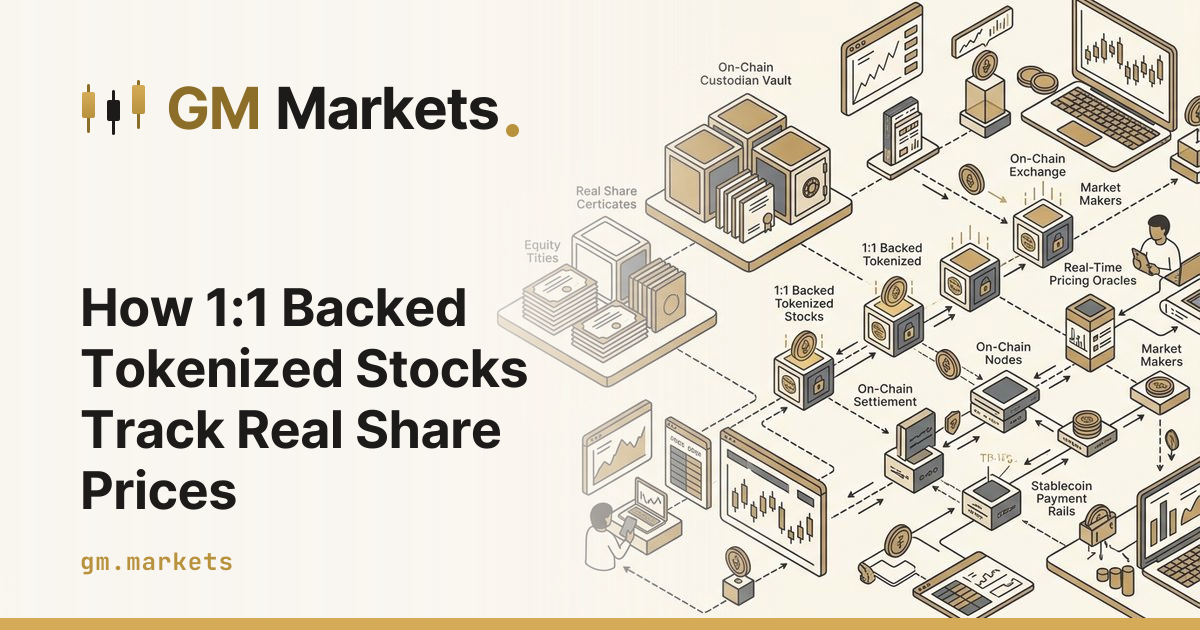
How 1:1 Backed Tokenized Stocks Track Real Share Prices
The price fidelity of a tokenized stock is not a given. It depends entirely on the token’s underlying structure. When you see a token representing a share of a company like NVIDIA or Apple, its ability to accurately track the real-world stock price comes down to one critical question: is the token a fully-backed digital twin of the asset, or is it a synthetic derivative?
This distinction is fundamental. A synthetic token tracks a price feed, but a fully-backed token represents a direct claim on the underlying share itself. At GM Markets, we exclusively use a 1:1 backed model. Every tokenized stock on our platform is a direct representation of a real share held in custody, ensuring its value is directly and verifiably tied to the actual market price. This price integrity is maintained by three core pillars: 1:1 asset backing with on-chain proof of reserves, a real-time Request-for-Quote (RFQ) pricing mechanism tied to live market data, and a total-return model that accurately incorporates dividends and corporate actions.
The Foundation: 1:1 Backing and Verifiable Reserves
The principle of 1:1 backing is simple but powerful. For every single tokenized stock we issue, one corresponding share of the actual company stock is purchased and held in a segregated customer account at a regulated U.S. broker-dealer, such as Interactive Brokers or Alpaca Markets. This creates an unbreakable link between the digital token and its real-world counterpart. The token is not a synthetic instrument that merely mimics the price; it is a certificate of ownership for a share held in custody on your behalf.
These shares are protected under U.S. regulations. As mandated by the SEC's Customer Protection Rule, customer assets must be kept separate from the brokerage firm's own funds. This segregation means that in the event of a broker's failure, these assets are not available to general creditors and are intended to be returned to customers. The Securities Investor Protection Corporation (SIPC) provides further protection, covering customer accounts up to $500,000 per client for missing assets.
To make this backing transparent and trustless, we provide a real-time, on-chain Proof of Reserves. This system uses Accountable, a third-party attestation service, to read our custodied balances directly from our brokers and publish the data on-chain. You can visit our Proof of Reserves page at any time to see the total supply of each tokenized stock and verify that it matches the number of real shares held in custody, confirming the 100% backing ratio.

The Pricing Mechanism: Real-Time Request-for-Quote (RFQ) Execution
Accurate backing is only one part of the equation. The price you receive when you trade must also reflect the live market. To achieve this, our platform uses a Request-for-Quote (RFQ) execution model. When you initiate a trade, we do not use an internal price. Instead, we send a request to our network of regulated market-making partners who compete to provide the best price.
These partners generate their quotes by referencing the live price of the underlying stock on major exchanges. Their benchmark is the National Best Bid and Offer (NBBO), a consolidated quote mandated by the U.S. Securities and Exchange Commission (SEC). The NBBO represents the best available buy and sell price for a stock across all U.S. exchanges at any given moment. By sourcing quotes directly against the NBBO, the price you see on GM Markets is a direct reflection of the real-time, institutional-grade market price.
This model offers significant advantages over trading on a public order book for certain assets, as it can reduce the price impact of large trades. To protect you from sudden price movements during the few seconds it takes to receive a quote, you can configure your own slippage tolerance. If the market price moves beyond your set tolerance before you confirm the trade, the order will not execute, protecting you from an unexpected price.

Accounting for Dividends and Corporate Actions
A frequent question from users is how dividends are handled with tokenized stocks. Our platform uses a total-return model to ensure the token’s value continues to track the total economic value of the underlying share seamlessly. When a company like Apple pays a dividend, the cash payment is received by the custodian holding the underlying shares.
This dividend payment is then automatically used to purchase more of the underlying AAPL shares. This action increases the total number of real shares backing the pool of tokenized AAPL, which in turn increases the on-chain Net Asset Value (NAV) of each individual token. You see the value of the dividend reflected directly in the price of your tokenized stock, rather than receiving a separate cash distribution. This model ensures the token's value perfectly tracks the share's total return and can simplify tax considerations, as a taxable event generally only occurs upon the sale of the asset.
Other corporate actions, such as stock splits or mergers, are handled in a similar manner. The token's structure is adjusted to absorb the event, ensuring that the 1:1 value peg to the real-world security is always maintained without requiring any action from you.

Why Backed Tokens Offer More Direct Exposure Than Synthetics
It is important to distinguish 1:1 backed tokens from synthetic assets. Synthetic tokenized stocks are derivatives that use price oracles to track a stock's price, but they are not backed by the actual underlying share. This structure introduces significant counterparty risk. If the issuer of a synthetic token fails, holders may be left with a worthless asset, as there is no underlying share to claim.
Global regulators are increasingly focused on these risks. The European Securities and Markets Authority (ESMA), for example, has warned of the "specific risk of investor misunderstanding" with synthetic models, where investors may incorrectly believe they own the underlying shares. Similarly, the Financial Stability Board (FSB) has highlighted how liquidity mismatches in synthetic arrangements could cause a token's value to deviate from the real asset's price.
A 1:1 backed token from GM Markets is not a derivative. It represents a direct claim on a real share held in a secure, regulated, and transparent custody arrangement. This structure is designed to eliminate the counterparty and de-pegging risks inherent in synthetic models, providing a more robust and reliable form of on-chain equity exposure.
Frequently Asked Questions
Is the price on GM Markets identical to the price on a stock ticker?
The price is extremely close, as it is based on the real-time NBBO from the underlying market. The final quoted price you see is inclusive of our trading fee (10 to 20 basis points), so the amount of the asset you will receive is final. This provides full transparency before you execute your trade.
What happens if the market price moves while my trade is being quoted?
Our RFQ system is designed for speed, but markets can move in seconds. Your trade is protected by a user-configurable slippage tolerance. If the price moves against you by more than your set percentage during the quoting window, the trade will not execute, and you will be presented with a new quote.
How do I verify that the tokens are actually backed by real shares?
You can verify our 1:1 backing at any time on our Proof of Reserves page. It shows a live, on-chain attestation from our third-party partner, Accountable, which continuously compares the total supply of our tokens to the number of shares held at our partner brokers.
How are after-hours trades priced?
For U.S. stocks, trading hours are fixed. If you place an order outside of market hours, it is queued on-chain. The order will be filled automatically at the prevailing market price when the market reopens and liquidity becomes available.
Price Fidelity Through Transparency and Structure
Ensuring a tokenized stock accurately tracks its real-world counterpart is not magic. It is the result of a deliberate and transparent financial structure. By combining 1:1 asset backing in segregated accounts, a real-time RFQ pricing mechanism tied to the NBBO, and a total-return model for dividends, we ensure that the tokenized stocks on our platform are a high-fidelity digital representation of real-world equity.
This model provides direct economic exposure to the underlying asset, grounded in verifiable on-chain data and robust custody arrangements. Please remember that all trading involves risk. The value of tokenized stocks can go down as well as up, and you may lose the money you invest. Tokenized assets carry specific risks, including smart contract, settlement, and custody risks. This content is for informational purposes only and does not constitute financial, investment, tax, or legal advice.
GM Markets does not offer services to users in the United States or other restricted jurisdictions. To learn more about our comprehensive custody and operational model, please visit our Security page.
Sources
- binance.com
- ledgerinsights.com
- binance.com
- tokenizer.estate
- mckinsey.com
- binance.com
- ripple.com
- snsinsider.com
- bcg.com
- coingecko.com
- weforum.org
- assettokenization.com
- a16zcrypto.com
- sofi.com
- schwab.com
- wikipedia.org
- finra.org
- finra.org
- finra.org
- dig.watch
- bitmarkets.com
- financemagnates.com
- europa.eu
- bitcoinmagazine.com
- seekingalpha.com
- tradingview.com
- fsb.org
- fsb.org
- bis.org
- coingeek.com
- finovate.com
- libertify.com
- boletininternacionalcnmv.es
- tradersmagazine.com
- aoshearman.com
- osl.com
- cube.exchange
- finchtrade.com
- river.com
- liquidmercury.com
- globaltrading.net
- etfstrategy.com
- coinbase.com
- wikipedia.org
- bloomberg.com
- etfstream.com
- tradersmagazine.com
- cmegroup.com
- sandhillglobaladvisors.com
- ml.com
- fidelity.com
- sipc.org
- sipc.org
- chase.com
- sipc.org
- investor.gov
- schwab.com
- interactivebrokers.com
- reddit.com