Fully-Backed vs. Synthetic: How Modern Tokenized Stocks Work
Learn the critical differences between synthetic assets and modern, fully-backed tokenized stocks. Explore how 1:1 backing, regulated custody, and on-chain attestation create a more secure standard.
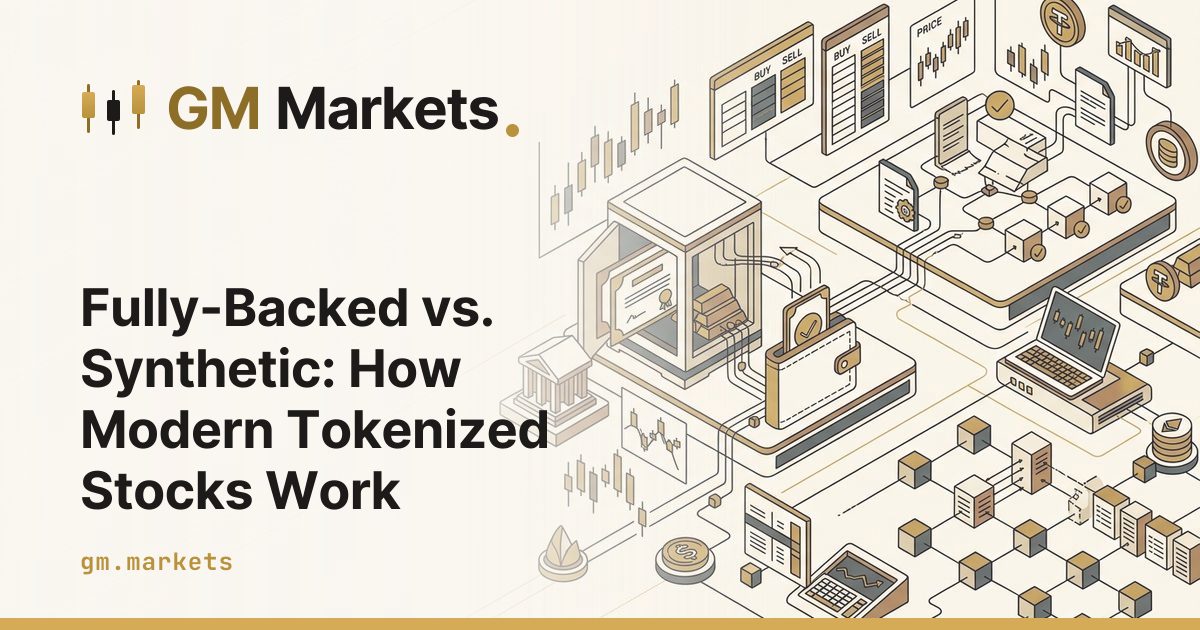
From Price Mimicry to Verifiable Ownership
The tokenization of real-world assets (RWAs) is a significant development in digital finance, creating more efficient and accessible markets. By representing assets like stocks on a blockchain, we unlock new levels of utility and composability. Projections from firms like Boston Consulting Group estimate the tokenized asset market could reach $16 trillion by 2030. Tokenized stocks are central to this, allowing global investors to gain equity exposure from their digital wallets.
The development of today's tokenized stocks involved a critical evolution. The first generation relied on synthetic models that introduced complex risks. In response, the market has moved to a higher standard: fully-backed, transparently attested tokens that represent genuine economic ownership. At GM Markets, our platform is built on this modern standard. This post explains the transition from opaque derivatives to verifiable, 1:1 backed assets.

The First Generation: Synthetic Stocks and Their Flaws
The earliest on-chain stocks used a derivative model. These synthetic assets were on-chain tokens designed to track the price of a real-world asset, but they did not represent ownership of the underlying share. Two prominent early examples were Mirror Protocol and Synthetix.
These platforms operated on a similar principle. To create a synthetic stock, a user had to lock up a different, often volatile, cryptocurrency as collateral. Mirror Protocol, for example, required users to over-collateralize with the algorithmic stablecoin UST to mint "mAssets" like mAAPL. Synthetix required staking its native SNX token at a high collateralization ratio to mint synthetic stocks like sTSLA.
This model presented several fundamental problems:
- Counterparty Risk: The token's value was dependent on the stability of the collateral. If the collateralizing asset collapsed, as UST did, the system could fail, leaving token holders with worthless assets.
- Oracle Risk: The protocols used external data feeds, or oracles, to report the stock price. These could be manipulated or fail, causing the synthetic token's price to diverge from the real asset's price.
- No Direct Claim: Holders of synthetic tokens had no legal claim on the actual shares. They had price exposure only, which meant no shareholder rights and inconsistent or non-existent handling of dividends and stock splits.
These risks proved to be systemic. The collapse of the Terra ecosystem in 2022 eliminated Mirror Protocol. The U.S. Securities and Exchange Commission (SEC) later charged its parent company with securities fraud, alleging that mAssets were part of a fraudulent scheme. Global regulators, including the International Organization of Securities Commissions (IOSCO), have since clarified that synthetic assets mimicking securities are often treated as derivatives and subject to strict regulation. This fragility and regulatory pressure made it clear a more robust model was required.

The Modern Standard: How Fully-Backed Tokenized Stocks Work
The failure of under-collateralized models led to a market-wide shift toward assets with transparent, verifiable reserves. For tokenized assets to be a reliable part of the financial system, they needed institutional-grade infrastructure. This is the foundation of the fully-backed model, which is built on three pillars: 1:1 asset backing, custody by regulated institutions, and real-time on-chain attestation.

1. Direct 1:1 Asset Backing
The core principle of the fully-backed model is that for every token issued on a blockchain, one corresponding share of the real-world stock is held in reserve. This creates a direct 1:1 relationship between the digital token and the traditional asset. The total supply of a tokenized stock, such as our tokenized NVDA, will always match the number of actual NVIDIA shares we hold in custody. This structure ensures the token’s value is directly and verifiably tied to the real-world stock's performance.
2. Custody with Regulated Brokers
To ensure the security of the underlying assets, we hold them in segregated customer accounts at regulated, third-party broker-dealers. On our platform, these partners are **Interactive Brokers** and **Alpaca Markets**. This arrangement is critical for investor protection because it separates customer assets from our own corporate funds. In the event we discontinue operations, this segregation protects token holders' claims on the underlying shares. You can learn more about our custody model on our Security page.
3. Real-Time On-Chain Attestation
A key innovation of the fully-backed model is the ability to independently verify collateralization in real time. We achieve this through a Proof of Reserve (PoR) mechanism provided by our independent partner, **Accountable**. Accountable's system reads data directly from our custodial accounts at the brokers and publishes it on-chain. This allows anyone, at any time, to verify that the number of tokens in circulation is fully backed by the corresponding real-world shares. This real-time transparency prevents issues like fractional reserve practices and builds confidence in the asset. You can view the live data for every asset we offer on our Proof of Reserves page.
Dividends and Corporate Actions: The Total-Return Model
A significant advantage of the fully-backed model is how it handles shareholder entitlements like dividends. Synthetic asset protocols were primarily concerned with mimicking price and did not typically pass on dividends to token holders. Corporate actions like stock splits often resulted in the synthetic asset being delisted because it was too difficult to reflect the changes accurately.
Our fully-backed tokens use a total-return model. Instead of paying out dividends as cash, the dividend payments are automatically used to purchase more of the underlying stock. This action increases the net asset value (NAV) of the token, meaning each token now represents a slightly larger amount of the underlying share. The value of the dividend is reflected directly in the token's price. This automated reinvestment allows you to benefit from the compounding effect of dividends without any manual action and simplifies the tax implications of distributions. Other corporate actions, such as stock splits, are handled automatically by adjusting the number of tokens you hold to ensure your economic exposure remains consistent.

Trading Fully-Backed Tokens on GM Markets
The fully-backed model provides the direct economic exposure of owning a stock with the efficiency and composability of a crypto asset. When you trade on our platform, you are interacting with tokens that are verifiably backed by real-world shares, held securely at regulated institutions. Our pricing model is straightforward, with a single trading fee from 0.10% to 0.20% included in the quoted price.
It is important to understand the nature of these assets and the terms of our service. The tokens provide you with economic exposure to the underlying stock, but they do not confer shareholder voting rights. All trading and investment activities carry risk. Markets can be volatile, and you may lose money. GM Markets does not provide financial, investment, tax, or legal advice, and you should consider your own financial situation before trading. For a full description of the risks, please see our Risk and Legal Disclosures.
Our platform is not offered to users in the United States or other restricted jurisdictions. It is your responsibility to ensure you are compliant with the laws of your locality.
Frequently Asked Questions
What is the main difference between a synthetic and a fully-backed tokenized stock?
A fully-backed tokenized stock is collateralized 1:1 by a real share held in a segregated account at a regulated broker. A synthetic asset is a derivative that only tracks the price of a stock, typically backed by a different, often volatile, crypto asset as collateral, and it represents no direct claim on the underlying share.
Do I own the underlying share with a fully-backed token?
You have a direct claim on the economic value of the underlying share. The token represents your beneficial ownership, held in custody on your behalf. While this provides price exposure and dividend rights through the total-return model, it does not typically include shareholder voting rights.
How are reserves verified on GM Markets?
We use a third-party attestation provider, Accountable, to conduct real-time Proof of Reserves. Accountable continuously monitors the shares held in our segregated accounts at brokers like Interactive Brokers and Alpaca Markets and posts this data on-chain, where it can be compared against the total supply of tokens.
Conclusion: The Standard for On-Chain Equities
The evolution from synthetic assets to fully-backed tokens represents a critical maturation for on-chain finance. The modern standard prioritizes security, transparency, and a direct link to real-world value. By using 1:1 backing, regulated custody, and real-time on-chain attestation, we provide a robust foundation for bringing global equity markets onto the blockchain. This model moves beyond simple price tracking to offer genuine economic exposure, complete with the benefits of dividends and corporate actions. To get started, you can explore our available markets, such as our tokenized S&P 500 ETF (SPY).