Fractional Shares Explained: How to Own Stocks for $1
Fractional shares allow you to own a piece of a stock for as little as $1. Learn how they work, why tokenization is the next evolution, and how new rules reveal their market impact.
Fractional Shares Explained: How to Own Stocks for $1
Fractional shares represent ownership of less than one full share of a company's stock or an exchange-traded fund (ETF). This innovation has fundamentally changed market access, making it possible to own a piece of high-priced stocks for as little as $1. Instead of needing to purchase one entire share, which can be prohibitively expensive, you can invest a specific dollar amount. For instance, a stock trading at $1,000 per share can be purchased for just $1, which buys 0.001 shares of that stock.
This method, often called dollar-based investing, allows you to gain economic exposure to a company's performance without committing a large amount of capital. Consider a stock like Berkshire Hathaway Inc. (BRK.A), which has historically traded for over $600,000 per share. Without fractional ownership, participating in its growth would be impossible for most individuals. With fractional shares, an investor can allocate a small sum, like $100, and own a piece of the company, benefiting proportionally from any price appreciation or dividends.
The Mainstream Rise of Fractional Trading
Fractional share investing has moved from a niche offering to a significant force in the market. This growth is driven by retail investors seeking greater access and flexibility. Recent data, made more transparent by new regulatory reporting rules, quantifies this impact. As of February 26, 2024, the Financial Industry Regulatory Authority (FINRA) began requiring trade reports to include fractional quantities up to six decimal places, revealing the true scale of this activity. This change was first detailed in a FINRA Trade Reporting Notice and was designed to enhance market transparency.
According to a March 2024 report from NYSE Research, in the first few weeks of this new reporting, 18.09% of all trades in the highest-priced stocks included a fractional component. For certain popular stocks, the effect is even more pronounced. For instance, fractional-quantity transactions accounted for half of all trades in NVIDIA (NVDA) reported to one of FINRA's Trade Reporting Facilities during that period. This data confirms that a substantial portion of daily trading volume now involves these smaller, more accessible positions, a trend noted by Nasdaq as essential for accurately reflecting modern retail trading behavior. This shift underscores the importance of fractional shares in today's equity markets.
Key Advantages of Investing with Fractional Shares
The rise of fractional share investing is due to several powerful benefits for individual investors.
- Accessibility: The most direct benefit is gaining access to high-performing but expensive stocks. Companies like NVR, Inc. (NVR) and AutoZone, Inc. (AZO) trade for thousands of dollars per share, but fractional investing puts them within reach of any investor.
- Diversification: A core principle of risk management is diversification, or spreading investments across many different assets. Fractional shares make this far easier to achieve with a small amount of capital. You can build a portfolio of dozens of different stocks with a few hundred dollars, a task that would require tens of thousands of dollars if you had to buy whole shares.
- Precise Allocation: Fractional shares allow you to invest exact dollar amounts. A strategy that requires allocating 15% of a $500 portfolio to a specific stock allows for an exact investment of $75, rather than being forced to buy the nearest whole share, which could disrupt allocation targets.
- Dollar-Cost Averaging: This is a strategy where you invest a fixed amount of money at regular intervals, regardless of market fluctuations. Fractional shares are ideal for this, as you can consistently invest your target amount, acquiring more shares when the price is low and fewer when it is high.

How Is Fractional Ownership Possible? Two Competing Models
The ability to own a fraction of a share is a structural solution offered by financial platforms. How that solution is engineered has significant implications for transparency, security, and what you can do with your asset. There are two primary models in the market today.
The Traditional Brokerage Model
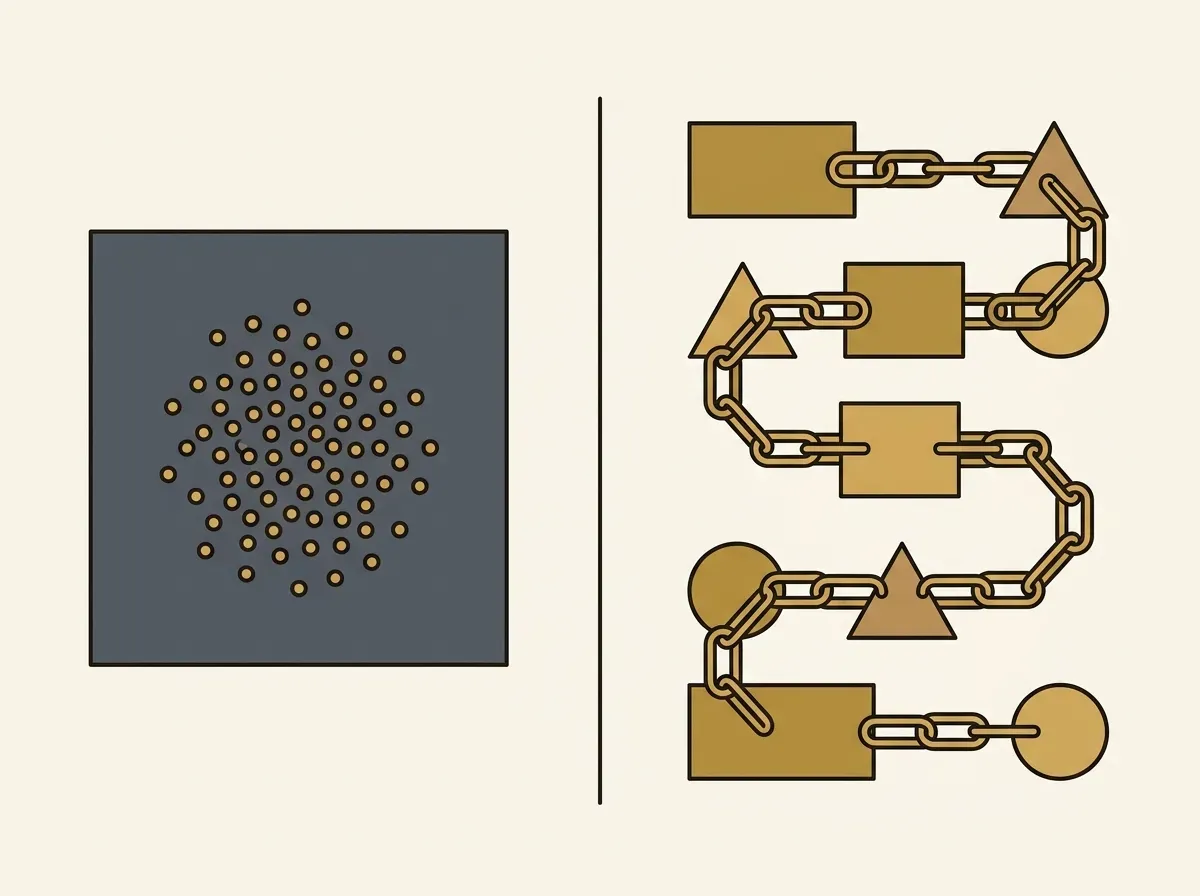
Most traditional online brokerages facilitate fractional ownership through an internal accounting system. When you buy a fractional share, the brokerage typically purchases whole shares and holds them in a single, commingled account known as an omnibus account. The firm is the legal owner of these shares, and it maintains an internal ledger that tracks how many fractions each of its customers beneficially owns.
While this system is regulated under rules like the SEC's Customer Protection Rule (15c3-3) to segregate customer assets, your ownership is essentially a bookkeeping entry on the broker's private ledger. You have a claim on the value of the fraction, but you do not directly hold the asset yourself. This can introduce limitations, such as an inability to transfer your fractional position to another brokerage.
The Tokenized Model on GM Markets
We built our platform on a different model designed for greater transparency and user control. For every tokenized stock available on GM Markets, we purchase a real, full share of the underlying stock and hold it in a segregated customer account at a regulated custodian, such as Interactive Brokers or Alpaca Markets. We then issue a standard ERC-20 token on-chain that represents a direct, fractional claim on that underlying share.
This means your ownership is not just an entry in a private database. It is a cryptographic asset that you control in your own wallet. The 1:1 backing of every token is continuously verified in real time by an independent third party, and you can see this data for yourself on our Proof of Reserves page. This creates an auditable and transparent link between your token and the real-world share it represents.
Why Tokenized Fractional Shares Are the Next Evolution
While traditional fractional investing democratized access, tokenization enhances ownership. The on-chain model offers distinct advantages over the legacy ledger-based approach.

True Self-Custody
With a traditional broker, your fractional share exists as an IOU on their books. On our platform, your tokenized fractional share is a standard on-chain asset that lives in your self-custodial wallet. You have direct control over your assets, secured by cryptography, not by a company's internal accounting system. This is made possible through advanced wallet infrastructure that prioritizes user control without adding complexity.
How Privy and MPC Secure Your Assets
Our embedded wallets are operated by Privy, which uses a form of Multi-Party Computation (MPC) to secure your account. Instead of a single private key that can be lost or stolen, MPC splits the key into multiple 'shares'. To sign a transaction, a certain threshold of these shares must be brought together. Specifically, we use a battle-tested method called Shamir's Secret Sharing in a '2-of-3' setup:
- One share is stored on your active device (like your phone or computer browser).
- A second share is encrypted and stored by Privy, accessible only after you authenticate.
- A third, encrypted recovery share is held by a recovery service to help you regain access if you lose your device.
No single party, including GM Markets or Privy, ever has access to the full key. To authorize a transaction, two of these three shares are used to momentarily reconstruct the key in a secure, isolated environment and sign. The complete key is destroyed immediately after use. This eliminates single points of failure and gives you control over your assets.
On-Chain Composability
This is where tokenization unlocks new potential. Because your tokenized stock is a standard crypto asset, it can interact with the broader decentralized finance (DeFi) ecosystem. You can use your tokenized stock position as collateral to borrow assets in a lending protocol, provide liquidity to a decentralized exchange, or integrate it into other on-chain strategies. Your investment transitions from a static holding into productive capital.
Example: Supplying Tokenized Stock to Aave
Aave is one of DeFi's largest lending protocols. You can supply your tokenized stocks, like gmAAPL, to earn interest or use them as collateral to borrow other assets like stablecoins. The process is straightforward:
- Connect Wallet: You start by connecting your wallet to the Aave application.
- Supply Asset: From the Aave dashboard, you select the tokenized stock you wish to supply and specify the amount.
- Borrow: Once your asset is supplied, it acts as collateral. You can then navigate to the borrowing section and take out a loan against your position, gaining liquidity without having to sell your stock.
Example: Using Morpho for Isolated Lending
Morpho is a lending protocol that allows for the creation of isolated, permissionless markets. Each market consists of a specific loan asset and a specific collateral asset. This allows for more tailored risk management. Using your tokenized stocks on Morpho follows a similar pattern:
- Connect Wallet: Connect your wallet to the Morpho application.
- Find Market: You would find an isolated market that accepts your specific tokenized stock as collateral, for example, a 'gmNVDA / USDC' market.
- Supply and Borrow: You supply your gmNVDA tokens to that market and can then borrow USDC against it, up to the market's specified loan-to-value ratio.
Enhanced Transparency
The traditional omnibus account model requires you to trust that the broker is managing its books correctly. Our model makes this trust verifiable. Anyone can audit the 1:1 backing of our tokens on-chain through our real-time Proof of Reserves attestation. This provides a level of transparency that is structurally impossible in the old system.
Global, Permissionless Access
Traditional brokerages often present significant friction for international users trying to access U.S. equity markets. Our platform is built on open, permissionless rails, allowing users from around the world to onboard with a wallet and gain exposure to these markets. Please note that our services are not offered to users in the United States or other restricted jurisdictions.
Frequently Asked Questions
Do you receive dividends with fractional shares?
Yes, you are entitled to the economic benefit of dividends. On GM Markets, we use a total-return model. When a company like Apple (AAPL) pays a dividend, the funds are automatically used to purchase more of the underlying AAPL shares held in custody. This increases the net asset value (NAV) of the tokenized AAPL, causing its price to rise proportionally. You see the value of the dividend reflected in the price of your asset rather than as a separate cash payment.
Are fractional shares 'real' shares?
When you hold a tokenized fractional share on our platform, it represents a real, verifiable claim on a portion of a whole share held 1:1 in custody. You have full economic exposure to the asset's price movements and dividends. It is important to understand the distinction between this economic ownership and legal ownership. As is common across the industry, holding a fractional share does not typically grant you shareholder voting rights. Major brokers like Charles Schwab and Fidelity have similar policies where only whole shares confer voting rights.
What are the risks associated with fractional ownership?
All investments carry market risk, meaning the value of your assets can go down as well as up. Beyond this, tokenized assets carry specific risks, including smart contract vulnerabilities, counterparty risk with custodians, and settlement risk. We work to mitigate these risks through rigorous smart contract audits and by partnering with regulated financial institutions. We encourage you to read our risk and legal disclosures to fully understand the risks before trading.
Start Trading Fractional Shares on GM Markets
Fractional share ownership has opened the doors to the global equity markets for millions of new investors. By allowing for dollar-based investing, it provides a powerful tool for building a diversified portfolio with any amount of capital. The evolution to tokenized, on-chain fractional shares brings a new level of transparency, self-custody, and utility to this innovation.
On GM Markets, you can start with as little as $1 and gain exposure to leading stocks and ETFs, all while holding your assets directly in your own wallet. Explore the available markets on our platform and experience the next generation of fractional investing.